
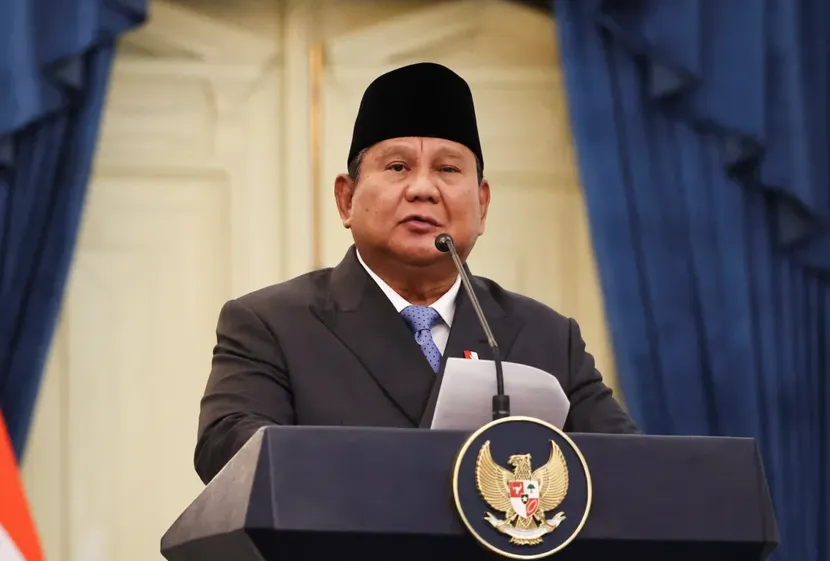
Indonesian President Prabowo Subianto recently stated at the 79th National Cooperative Day celebration that Indonesians are naturally hospitable, even borrowing coffee and sugar from neighbors to entertain guests when they have none at home. However, "some guests do not know their limits, showing up uninvited, claiming to do business, but over time turning to plunder." Some domestic media commented that he did not name any country or company, but afterward, speculation arose in public opinion regarding the identity of the "guests." The main theme of Prabowo's speech was to criticize neoliberalism as "contrary to the 1945 Constitution," criticize wealth outflows and corruption in state-owned enterprises, and mobilize support for the "Red and White Village Cooperative" plan. After the "guest" remark, Prabowo immediately stated, "We are not opposed to big enterprises," emphasizing the need for cooperatives, micro, small, and medium enterprises, private enterprises, and state-owned enterprises, and that "strengthening cooperatives does not mean weakening others."
Additionally, at the groundbreaking ceremony for the Masela LNG project later, he reiterated that Indonesia is open to all countries and partners willing to cooperate mutually, while emphasizing that Indonesia is now "mature" and will defend its own interests. This series of statements comes against the backdrop of some of Prabowo's economic policy reforms, including the free lunch program and the "Red and White Cooperatives," which have sparked some public criticism within Indonesia. Looking at the context of his remarks, it is not difficult to see that Prabowo's出发点 lies more in motivating and building confidence among the people. As far as relations with China are concerned, Prabowo himself places great importance on cooperation with China. He chose China for his first overseas visit after taking office, and the two countries reached consensus on building a community with a shared future with regional and global influence, as well as joint maritime development. He also expressed support for China's long-standing support for developing countries and opposition to colonialism.
More importantly, China-Indonesia cooperation itself stands the test of facts. Bilateral cooperation operates within the framework of Indonesian laws and regulations, with the Regional Comprehensive Economic Partnership (RCEP) and the China-ASEAN Free Trade Area providing rules and dispute resolution channels. In 2025, bilateral trade reached $167.49 billion, a year-on-year increase of 13.4%. China has been Indonesia's largest trading partner for 13 consecutive years and ranked among Indonesia's top three sources of foreign investment for 10 consecutive years, with direct investment of $7.5 billion in Indonesia in 2025. According to Chinese customs statistics, China's imports from Indonesia grew by 15.6%, faster than its exports to Indonesia, with bilateral trade roughly balanced. Even if there is a deficit by Indonesia's calculation, its imports from China are predominantly industrial inputs such as machinery and electrical equipment.
The effectiveness of China-Indonesia cooperation is also documented. After Indonesia implemented a ban on raw mineral exports and promoted downstream processing, Chinese companies invested in smelting, processing, and battery supply chain facilities within Indonesia, making the country the world's second-largest producer and exporter of nickel-containing stainless steel, with added value retained domestically—contrary to the notion of "wealth being shipped out of the country." On July 12, the Jakarta-Bandung High-Speed Railway achieved 1,000 days of safe operation, carrying over 16.58 million passengers in total, averaging about 16,000 per day, driving commercial development around stations, with local employees gradually taking on key roles such as drivers and equipment maintenance.
China and Indonesia have maintained diplomatic relations for 76 years. Whether with the Jakarta-Bandung High-Speed Railway or industrial park construction, the two sides have maintained a strong momentum of cooperation. The Indonesian government has repeatedly stated publicly that it welcomes and supports Chinese enterprises to continue investing in Indonesia, further deepening mutually beneficial cooperation between the two countries. Against the backdrop of complex and changing international situations, strengthening cooperation among regional countries and maintaining regional development momentum is a common aspiration. The upward trend of China-Indonesia cooperation and China-ASEAN cooperation will not change in the future.


