
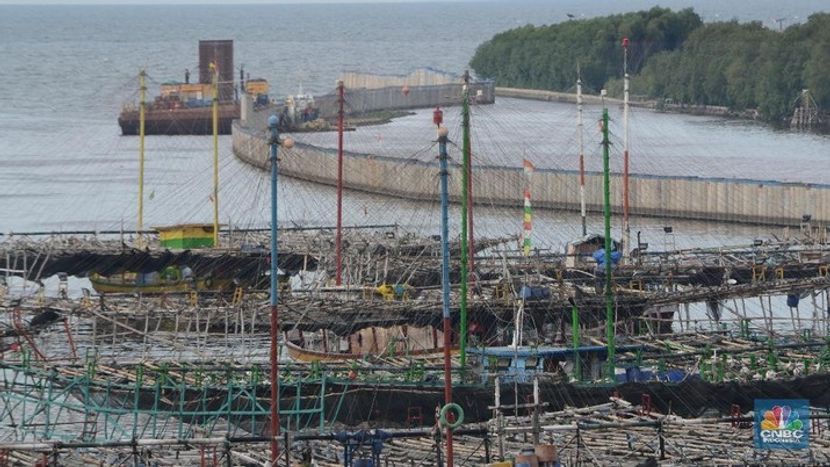
 President-elect Prabowo plans to cooperate with Chinese investors to develop a massive sea wall along the northern coast of Java Island.The Deputy Chairman of the Gerindra Party Advisory Board stated that he has approached several companies from China. He has been to Beijing twice and Hong Kong twice, and some are interested. In China, the real estate business has saturated, so they are interested in entering the sea wall project. Prabowo's concept for the giant sea wall project will implement a Government and Business Entity Cooperation (KPBU) scheme, where the government holds a 20% stake and the private sector holds 80%. Interested developers are welcome, but he has heard that there are already major developers interested in financing this large project, possibly 10 kilometers held by one party, and another 10 kilometers by others. Prabowo's younger brother stated that the giant sea wall project was actually initiated since 1994 during the New Order government under Bappenas, but has not yet been completed. The planning for the giant sea wall project was revived 10 years ago, with discussions involving Dutch consultants, and Prabowo intends to continue this idea starting from the Jakarta waters.
Prabowo's idea is that the sea wall will start from Jakarta and later extend to Surabaya and Gresik. This is to protect the coast of Java Island, as there are indications that climate change is causing sea levels to rise. The reason is that up to 40% of Indonesia's rice fields are located on the north coast of Java. If the rice fields sink, national food security will be threatened. If water levels drop, establishing food security programs in Papua or Kalimantan would be meaningless. If we do not want to lose the rice fields on Java, then a massive sea wall will be built. Even so, he emphasized that even if Prabowo can be re-elected for two terms, the giant sea wall project will not be completed during his administration, and he estimates this project will last 20-30 years. Previously, the Minister of Public Works and Public Housing (PUPR) held a meeting with the Nanjing Hydraulic Research Institute (NHRI) to explore cooperation opportunities in building breakwaters and various types of sea wall structures. Following this meeting, the NHRI team plans to visit Indonesia in the near future. NHRI will review existing basic design data and research reports prepared by an expert team comprising South Korean, Dutch, and PUPR Ministry teams. During this discussion, he emphasized the importance of utilizing the Bandung Water Resources Laboratory and the North Bali Coastal Laboratory to create physical models for marine health. The financing plan will adopt a loan scheme.
Traditional breakwaters are usually made of crushed stone from mountain blasting, have long construction times, and are easily damaged by storms. The National Research Institute has developed a new innovation in the form of caisson-type breakwaters, with a top design resembling the figure "8" and an elliptical bottom, which will be buried quite deep into the ground. This innovation has been implemented along 27 kilometers of Jiangsu Province in China. This new innovative technology is heavier and more wave-resistant, can reduce construction time by three times, and save up to 30% in costs. In addition to functioning as a wave breaker, this structure can also be used for riverbank protection and is being developed for wind turbines. The Chief Expert Engineer of the PUPR Ministry stated that the north coast of Java is facing the threat of coastal subsidence, with a land subsidence rate of 15-16 cm per year, and serious soft soil problems. Echo sounding is currently being conducted to collect bathymetric data and soil surveys to design a 22-kilometer long sea wall from Bekasi to Tangerang. This project is integrated with the sea wall design, where the sea wall can function both as a highway to reduce traffic congestion in Jakarta and as an estuary dam to store fresh water. However, community sanitation must first be improved because 13 rivers flow into the area, so that the dam does not become a septic tank.
President-elect Prabowo plans to cooperate with Chinese investors to develop a massive sea wall along the northern coast of Java Island.The Deputy Chairman of the Gerindra Party Advisory Board stated that he has approached several companies from China. He has been to Beijing twice and Hong Kong twice, and some are interested. In China, the real estate business has saturated, so they are interested in entering the sea wall project. Prabowo's concept for the giant sea wall project will implement a Government and Business Entity Cooperation (KPBU) scheme, where the government holds a 20% stake and the private sector holds 80%. Interested developers are welcome, but he has heard that there are already major developers interested in financing this large project, possibly 10 kilometers held by one party, and another 10 kilometers by others. Prabowo's younger brother stated that the giant sea wall project was actually initiated since 1994 during the New Order government under Bappenas, but has not yet been completed. The planning for the giant sea wall project was revived 10 years ago, with discussions involving Dutch consultants, and Prabowo intends to continue this idea starting from the Jakarta waters.
Prabowo's idea is that the sea wall will start from Jakarta and later extend to Surabaya and Gresik. This is to protect the coast of Java Island, as there are indications that climate change is causing sea levels to rise. The reason is that up to 40% of Indonesia's rice fields are located on the north coast of Java. If the rice fields sink, national food security will be threatened. If water levels drop, establishing food security programs in Papua or Kalimantan would be meaningless. If we do not want to lose the rice fields on Java, then a massive sea wall will be built. Even so, he emphasized that even if Prabowo can be re-elected for two terms, the giant sea wall project will not be completed during his administration, and he estimates this project will last 20-30 years. Previously, the Minister of Public Works and Public Housing (PUPR) held a meeting with the Nanjing Hydraulic Research Institute (NHRI) to explore cooperation opportunities in building breakwaters and various types of sea wall structures. Following this meeting, the NHRI team plans to visit Indonesia in the near future. NHRI will review existing basic design data and research reports prepared by an expert team comprising South Korean, Dutch, and PUPR Ministry teams. During this discussion, he emphasized the importance of utilizing the Bandung Water Resources Laboratory and the North Bali Coastal Laboratory to create physical models for marine health. The financing plan will adopt a loan scheme.
Traditional breakwaters are usually made of crushed stone from mountain blasting, have long construction times, and are easily damaged by storms. The National Research Institute has developed a new innovation in the form of caisson-type breakwaters, with a top design resembling the figure "8" and an elliptical bottom, which will be buried quite deep into the ground. This innovation has been implemented along 27 kilometers of Jiangsu Province in China. This new innovative technology is heavier and more wave-resistant, can reduce construction time by three times, and save up to 30% in costs. In addition to functioning as a wave breaker, this structure can also be used for riverbank protection and is being developed for wind turbines. The Chief Expert Engineer of the PUPR Ministry stated that the north coast of Java is facing the threat of coastal subsidence, with a land subsidence rate of 15-16 cm per year, and serious soft soil problems. Echo sounding is currently being conducted to collect bathymetric data and soil surveys to design a 22-kilometer long sea wall from Bekasi to Tangerang. This project is integrated with the sea wall design, where the sea wall can function both as a highway to reduce traffic congestion in Jakarta and as an estuary dam to store fresh water. However, community sanitation must first be improved because 13 rivers flow into the area, so that the dam does not become a septic tank.
Indonesia's North Java Sea Wall Project Plans to Attract Foreign Investment
www.indoent.com
2024-10-23
President-elect Prabowo plans to cooperate with Chinese investors to develop a massive sea wall along the northern coast of Java Island. The Deputy Chairman of the Gerindra Party Advisory Board stated that he has approached several companies from China. He has been to Beijing twice and Hong Kong twice, and some are interested. In China, the real estate business has saturated, so they are interested in entering the sea wall project. Prabowo's concept for the giant sea wall project will implement a Government and Business Entity Cooperation (KPBU) scheme, where the government holds a 20% stake and the private sector holds 80%. Interested parties
President-elect Prabowo plans to cooperate with Chinese investors to develop a massive sea wall along the northern coast of Java Island.The Deputy Chairman of the Gerindra Party Advisory Board stated that he has approached several companies from China. He has been to Beijing twice and Hong Kong twice, and some are interested. In China, the real estate business has saturated, so they are interested in entering the sea wall project. Prabowo's concept for the giant sea wall project will implement a Government and Business Entity Cooperation (KPBU) scheme, where the government holds a 20% stake and the private sector holds 80%. Interested developers are welcome, but he has heard that there are already major developers interested in financing this large project, possibly 10 kilometers held by one party, and another 10 kilometers by others. Prabowo's younger brother stated that the giant sea wall project was actually initiated since 1994 during the New Order government under Bappenas, but has not yet been completed. The planning for the giant sea wall project was revived 10 years ago, with discussions involving Dutch consultants, and Prabowo intends to continue this idea starting from the Jakarta waters.
Prabowo's idea is that the sea wall will start from Jakarta and later extend to Surabaya and Gresik. This is to protect the coast of Java Island, as there are indications that climate change is causing sea levels to rise. The reason is that up to 40% of Indonesia's rice fields are located on the north coast of Java. If the rice fields sink, national food security will be threatened. If water levels drop, establishing food security programs in Papua or Kalimantan would be meaningless. If we do not want to lose the rice fields on Java, then a massive sea wall will be built. Even so, he emphasized that even if Prabowo can be re-elected for two terms, the giant sea wall project will not be completed during his administration, and he estimates this project will last 20-30 years. Previously, the Minister of Public Works and Public Housing (PUPR) held a meeting with the Nanjing Hydraulic Research Institute (NHRI) to explore cooperation opportunities in building breakwaters and various types of sea wall structures. Following this meeting, the NHRI team plans to visit Indonesia in the near future. NHRI will review existing basic design data and research reports prepared by an expert team comprising South Korean, Dutch, and PUPR Ministry teams. During this discussion, he emphasized the importance of utilizing the Bandung Water Resources Laboratory and the North Bali Coastal Laboratory to create physical models for marine health. The financing plan will adopt a loan scheme.
Traditional breakwaters are usually made of crushed stone from mountain blasting, have long construction times, and are easily damaged by storms. The National Research Institute has developed a new innovation in the form of caisson-type breakwaters, with a top design resembling the figure "8" and an elliptical bottom, which will be buried quite deep into the ground. This innovation has been implemented along 27 kilometers of Jiangsu Province in China. This new innovative technology is heavier and more wave-resistant, can reduce construction time by three times, and save up to 30% in costs. In addition to functioning as a wave breaker, this structure can also be used for riverbank protection and is being developed for wind turbines. The Chief Expert Engineer of the PUPR Ministry stated that the north coast of Java is facing the threat of coastal subsidence, with a land subsidence rate of 15-16 cm per year, and serious soft soil problems. Echo sounding is currently being conducted to collect bathymetric data and soil surveys to design a 22-kilometer long sea wall from Bekasi to Tangerang. This project is integrated with the sea wall design, where the sea wall can function both as a highway to reduce traffic congestion in Jakarta and as an estuary dam to store fresh water. However, community sanitation must first be improved because 13 rivers flow into the area, so that the dam does not become a septic tank.
Tags
Industry News
Share to
Related Reading
 Industry Flash
Cheap Chinese Plastics Impact Indonesia's Petrochemical Industry, Association Calls for Protection
2026-09-03 Industry News
Investment Heat in Two Key Industrial Parks in Central Java Continues to Rise
2026-08-31 Industry News