
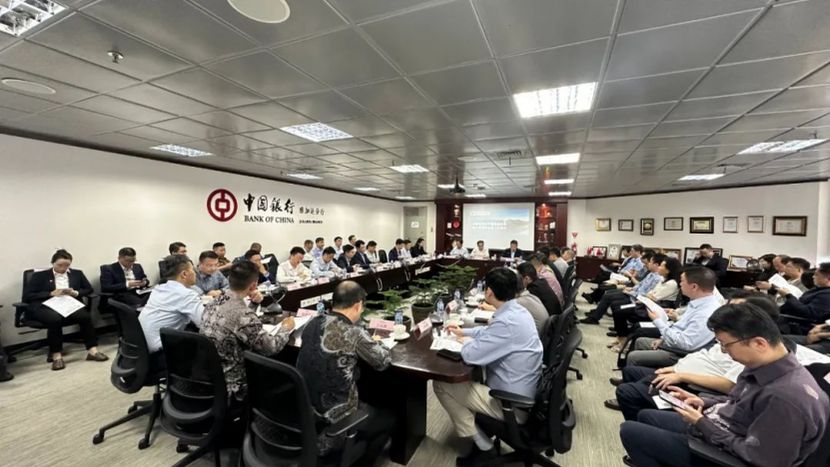
 The Second Meeting of the Ninth Council of the Indonesia China Chamber of Commerce was recently held in Jakarta. The meeting elected 6 executive vice presidents and 12 industry branch presidents, and passed the "Regulations on Duties and Work Rules of the Council Executive Committee". The new structure promotes reform and adjustments around the core mission of the chamber, aiming to enhance efficiency and assist Chinese enterprises in deeply cultivating the Indonesian market, injecting new momentum into building a new bilateral economic and trade landscape and strengthening practical cooperation. Li Hongwei, Minister Counsellor of the Chinese Embassy in Indonesia, Counsellor Wu Zhiwei, and Sun Shangbin, President of the Indonesia China Chamber of Commerce, attended and spoke at the meeting, with 60 council member units participating. The meeting pointed out that the chamber must first focus on its core business and implement targeted measures. The newly established 6 executive vice presidents will be responsible for the six major functions of "promotion, research, facilitation, guidance, service, and assurance." At the same time, the chamber has established 12 industry branches based on industrial characteristics and market demand, covering sectors such as new energy, trade and services, energy and commodities, information and communication, mining and metallurgy, e-commerce and platform economy, electricity and automotive, infrastructure, construction machinery, industrial parks and manufacturing, agriculture, forestry, fisheries and consumer goods, as well as transportation, logistics and finance. The new structure precisely targets enterprise needs, uses industrial synergy as a lever, and focuses on enhancing the chamber's service efficiency by building efficient matchmaking platforms, promoting localized cooperation, strengthening corporate branding, and safeguarding enterprise security and rights, assisting enterprises in further exploring the potential of the Indonesian market and achieving sustainable development. Second, it must take pragmatic actions and improve efficiency. Facing Indonesia's increasingly diversified market environment, all members of the chamber will quickly adapt to the new market structure, gain in-depth understanding of industry needs, and make precise efforts. The chamber will organize member units to deeply participate in local construction, further strengthen cooperation with the Indonesian government, China-Indonesia industry organizations and enterprises, and promote development in important fields such as energy, infrastructure, and the digital economy. By building efficient matchmaking platforms, the chamber will expand its influence in the Indonesian market and create more favorable conditions for China-Indonesia economic and trade cooperation. Third, it must focus on execution and be results-oriented. To ensure the smooth achievement of set goals, the chamber has clarified a work approach shifting from "problem-oriented" to "results-oriented," and will formulate detailed timetables and roadmaps to ensure the timely progress of various tasks. At the same time, the chamber will establish an assessment mechanism based on actual results, strictly control the quality of work implementation, and promote practical performance of duties by all departments. Through this series of concrete measures, the chamber strives to enhance the sense of belonging among member units through actual achievements, and further boost market confidence and competitiveness. Fourth, it must strictly enforce discipline and strengthen safeguards. Efficient operation requires orderly management as support. All departments of the chamber must strictly abide by rules and regulations and implement responsibilities. At the same time, internal supervision will be continuously promoted, performance evaluations will be implemented, and data-driven management will drive development assurance. Fifth, it must unite and gather wisdom. Indonesia's unique culture and economic advantages provide huge development potential for Chinese enterprises. All members of the chamber will work together, leverage collective wisdom, adhere to the principle of open cooperation, jointly explore new models of economic and trade cooperation, and create a more efficient and mutually beneficial cooperation ecosystem. This structural adjustment is an important milestone in the development of the chamber. In the future, the chamber will make unremitting efforts, with a stronger organizational foundation and innovative measures, to assist Chinese enterprises in exploring and advancing in Indonesia's fertile land, and inject greater momentum into promoting China-Indonesia bilateral cooperation.
Indonesia China Chamber of Commerce Deepens Reform Plan to Promote Development of Chinese Enterprises
www.indoent.com
2025-02-13
The Second Meeting of the Ninth Council of the Indonesia China Chamber of Commerce was recently held in Jakarta. The meeting elected 6 executive vice presidents and 12 industry branch presidents, and passed the "Regulations on Duties and Work Rules of the Council Executive Committee". The new structure promotes reform and adjustments around the core mission of the chamber, aiming to enhance efficiency and assist Chinese enterprises in deeply cultivating the Indonesian market, injecting new momentum into building a new bilateral economic and trade landscape and strengthening practical cooperation. Li Hongwei, Minister Counsellor of the Chinese Embassy in Indonesia, Counsellor Wu Zhiwei, and Sun Shangbin, President of the Indonesia China Chamber of Commerce, attended and spoke at the meeting, with 60 council member units participating.
The Second Meeting of the Ninth Council of the Indonesia China Chamber of Commerce was recently held in Jakarta. The meeting elected 6 executive vice presidents and 12 industry branch presidents, and passed the "Regulations on Duties and Work Rules of the Council Executive Committee". The new structure promotes reform and adjustments around the core mission of the chamber, aiming to enhance efficiency and assist Chinese enterprises in deeply cultivating the Indonesian market, injecting new momentum into building a new bilateral economic and trade landscape and strengthening practical cooperation. Li Hongwei, Minister Counsellor of the Chinese Embassy in Indonesia, Counsellor Wu Zhiwei, and Sun Shangbin, President of the Indonesia China Chamber of Commerce, attended and spoke at the meeting, with 60 council member units participating. The meeting pointed out that the chamber must first focus on its core business and implement targeted measures. The newly established 6 executive vice presidents will be responsible for the six major functions of "promotion, research, facilitation, guidance, service, and assurance." At the same time, the chamber has established 12 industry branches based on industrial characteristics and market demand, covering sectors such as new energy, trade and services, energy and commodities, information and communication, mining and metallurgy, e-commerce and platform economy, electricity and automotive, infrastructure, construction machinery, industrial parks and manufacturing, agriculture, forestry, fisheries and consumer goods, as well as transportation, logistics and finance. The new structure precisely targets enterprise needs, uses industrial synergy as a lever, and focuses on enhancing the chamber's service efficiency by building efficient matchmaking platforms, promoting localized cooperation, strengthening corporate branding, and safeguarding enterprise security and rights, assisting enterprises in further exploring the potential of the Indonesian market and achieving sustainable development. Second, it must take pragmatic actions and improve efficiency. Facing Indonesia's increasingly diversified market environment, all members of the chamber will quickly adapt to the new market structure, gain in-depth understanding of industry needs, and make precise efforts. The chamber will organize member units to deeply participate in local construction, further strengthen cooperation with the Indonesian government, China-Indonesia industry organizations and enterprises, and promote development in important fields such as energy, infrastructure, and the digital economy. By building efficient matchmaking platforms, the chamber will expand its influence in the Indonesian market and create more favorable conditions for China-Indonesia economic and trade cooperation. Third, it must focus on execution and be results-oriented. To ensure the smooth achievement of set goals, the chamber has clarified a work approach shifting from "problem-oriented" to "results-oriented," and will formulate detailed timetables and roadmaps to ensure the timely progress of various tasks. At the same time, the chamber will establish an assessment mechanism based on actual results, strictly control the quality of work implementation, and promote practical performance of duties by all departments. Through this series of concrete measures, the chamber strives to enhance the sense of belonging among member units through actual achievements, and further boost market confidence and competitiveness. Fourth, it must strictly enforce discipline and strengthen safeguards. Efficient operation requires orderly management as support. All departments of the chamber must strictly abide by rules and regulations and implement responsibilities. At the same time, internal supervision will be continuously promoted, performance evaluations will be implemented, and data-driven management will drive development assurance. Fifth, it must unite and gather wisdom. Indonesia's unique culture and economic advantages provide huge development potential for Chinese enterprises. All members of the chamber will work together, leverage collective wisdom, adhere to the principle of open cooperation, jointly explore new models of economic and trade cooperation, and create a more efficient and mutually beneficial cooperation ecosystem. This structural adjustment is an important milestone in the development of the chamber. In the future, the chamber will make unremitting efforts, with a stronger organizational foundation and innovative measures, to assist Chinese enterprises in exploring and advancing in Indonesia's fertile land, and inject greater momentum into promoting China-Indonesia bilateral cooperation.
Tags
Industry News
Share to
Related Reading
 Industry Flash
Cheap Chinese Plastics Impact Indonesia's Petrochemical Industry, Association Calls for Protection
2026-09-03 Industry News
Investment Heat in Two Key Industrial Parks in Central Java Continues to Rise
2026-08-31 Industry News