
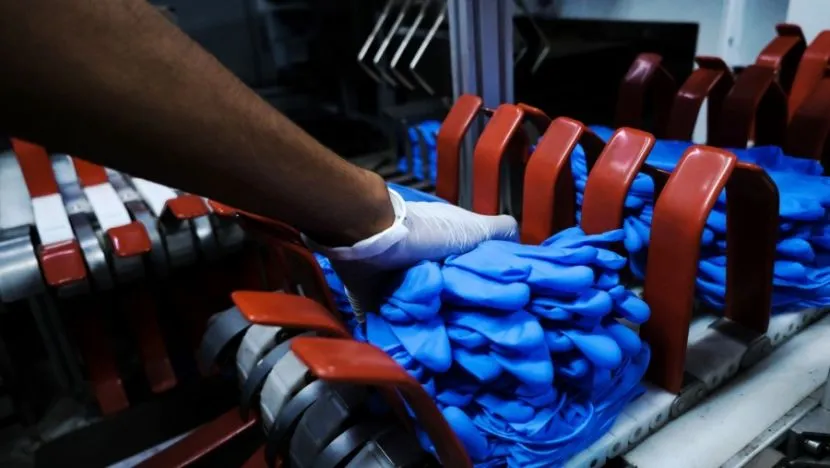
 Amid the global upgrade of medical protection demands and supply chain restructuring, China's leading disposable protective glove enterprise Zhonghong Medical is accelerating its overseas expansion, increasing the total investment in the Phase I 20 nitrile glove production lines at its Indonesia base from 1.092 billion yuan to 1.477 billion yuan, an increase of 35.26%. The core objective is to enhance production line efficiency and digital intelligence level, building internationally advanced production capacity. This capital increase mainly stems from two aspects of increased investment: first, to strengthen the long-term competitiveness of the new production lines in efficiency, cost, and product quality, significantly increasing investment in automation control, intelligent equipment, and supporting facilities by 380 million yuan, becoming the core driver of investment growth; second, civil engineering costs increased by 94 million yuan compared to the original plan to accommodate more advanced production line construction standards. Although investment has increased, project land costs have decreased compared to before, further optimizing the overall investment structure.
Industry analysis points out that the disposable glove industry is in a cyclical adjustment phase, with intensified market competition and pressure on profit margins. The key for leading enterprises at this time to deploy more advanced automated production lines in Southeast Asia is to optimize long-term cost structure, enhance product competitiveness, and prepare for the industry cycle recovery. Zhonghong Medical has clearly established a "dual circulation" production capacity system, implementing differentiated division of labor domestically and overseas: relying on the automation and scale advantages of the new generation dual-mold production lines, the Indonesia base is positioned for standardized, low-cost production, targeting the US and global bulk markets; while the domestic base focuses on domestic, non-US markets, and high-end customized products, complementing with rapid response capabilities.
The core competitive advantages of the Indonesia base are significant, including higher per capita output due to late-mover technology gap, upstream rubber raw material synergy, energy cost advantages, and long-term cost and quality control capabilities driven by digital intelligence-enabled fine management.
An industry special researcher indicated that overseas factory construction has long-cycle characteristics, and short-term huge capital expenditure may put pressure on cash flow and current profits. However, Indonesia, as a source of rubber raw materials and a hub connecting Europe, America, and emerging markets, has locational advantages. The key lies in whether enterprises can effectively manage cross-cultural management risks and supply chain resilience in the international trade environment. He also reminded that nearly 90% of fixed asset investment will significantly increase later depreciation, putting pressure on the profit statement in the short term. Attention should be paid to market digestion of new capacity and actual capacity utilization, as well as the impact of exchange rate fluctuations, policy uncertainty and other factors on actual returns.
Amid the global upgrade of medical protection demands and supply chain restructuring, China's leading disposable protective glove enterprise Zhonghong Medical is accelerating its overseas expansion, increasing the total investment in the Phase I 20 nitrile glove production lines at its Indonesia base from 1.092 billion yuan to 1.477 billion yuan, an increase of 35.26%. The core objective is to enhance production line efficiency and digital intelligence level, building internationally advanced production capacity. This capital increase mainly stems from two aspects of increased investment: first, to strengthen the long-term competitiveness of the new production lines in efficiency, cost, and product quality, significantly increasing investment in automation control, intelligent equipment, and supporting facilities by 380 million yuan, becoming the core driver of investment growth; second, civil engineering costs increased by 94 million yuan compared to the original plan to accommodate more advanced production line construction standards. Although investment has increased, project land costs have decreased compared to before, further optimizing the overall investment structure.
Industry analysis points out that the disposable glove industry is in a cyclical adjustment phase, with intensified market competition and pressure on profit margins. The key for leading enterprises at this time to deploy more advanced automated production lines in Southeast Asia is to optimize long-term cost structure, enhance product competitiveness, and prepare for the industry cycle recovery. Zhonghong Medical has clearly established a "dual circulation" production capacity system, implementing differentiated division of labor domestically and overseas: relying on the automation and scale advantages of the new generation dual-mold production lines, the Indonesia base is positioned for standardized, low-cost production, targeting the US and global bulk markets; while the domestic base focuses on domestic, non-US markets, and high-end customized products, complementing with rapid response capabilities.
The core competitive advantages of the Indonesia base are significant, including higher per capita output due to late-mover technology gap, upstream rubber raw material synergy, energy cost advantages, and long-term cost and quality control capabilities driven by digital intelligence-enabled fine management.
An industry special researcher indicated that overseas factory construction has long-cycle characteristics, and short-term huge capital expenditure may put pressure on cash flow and current profits. However, Indonesia, as a source of rubber raw materials and a hub connecting Europe, America, and emerging markets, has locational advantages. The key lies in whether enterprises can effectively manage cross-cultural management risks and supply chain resilience in the international trade environment. He also reminded that nearly 90% of fixed asset investment will significantly increase later depreciation, putting pressure on the profit statement in the short term. Attention should be paid to market digestion of new capacity and actual capacity utilization, as well as the impact of exchange rate fluctuations, policy uncertainty and other factors on actual returns.
Chinese Company Adds 380 Million Yuan to Expand Nitrile Glove Capacity in Indonesia
www.indoent.com
2026-03-26
Amid the global upgrade of medical protection demands and supply chain restructuring, China's leading disposable protective glove enterprise, Zhonghong Medical, is accelerating its overseas expansion, increasing the total investment in the Phase I 20 nitrile glove production lines at its Indonesia base from 1.092 billion yuan to 1.477 billion yuan, an increase of 35.26%. The core objective is to enhance production line efficiency and digital intelligence level, building internationally advanced production capacity. This capital increase mainly stems from two aspects of increased investment: first, to strengthen the long-term competitiveness of the new production lines in efficiency, cost, and product quality, significantly increasing investment in automation control, intelligent equipment, and supporting facilities, with an increase of
Amid the global upgrade of medical protection demands and supply chain restructuring, China's leading disposable protective glove enterprise Zhonghong Medical is accelerating its overseas expansion, increasing the total investment in the Phase I 20 nitrile glove production lines at its Indonesia base from 1.092 billion yuan to 1.477 billion yuan, an increase of 35.26%. The core objective is to enhance production line efficiency and digital intelligence level, building internationally advanced production capacity. This capital increase mainly stems from two aspects of increased investment: first, to strengthen the long-term competitiveness of the new production lines in efficiency, cost, and product quality, significantly increasing investment in automation control, intelligent equipment, and supporting facilities by 380 million yuan, becoming the core driver of investment growth; second, civil engineering costs increased by 94 million yuan compared to the original plan to accommodate more advanced production line construction standards. Although investment has increased, project land costs have decreased compared to before, further optimizing the overall investment structure.
Industry analysis points out that the disposable glove industry is in a cyclical adjustment phase, with intensified market competition and pressure on profit margins. The key for leading enterprises at this time to deploy more advanced automated production lines in Southeast Asia is to optimize long-term cost structure, enhance product competitiveness, and prepare for the industry cycle recovery. Zhonghong Medical has clearly established a "dual circulation" production capacity system, implementing differentiated division of labor domestically and overseas: relying on the automation and scale advantages of the new generation dual-mold production lines, the Indonesia base is positioned for standardized, low-cost production, targeting the US and global bulk markets; while the domestic base focuses on domestic, non-US markets, and high-end customized products, complementing with rapid response capabilities.
The core competitive advantages of the Indonesia base are significant, including higher per capita output due to late-mover technology gap, upstream rubber raw material synergy, energy cost advantages, and long-term cost and quality control capabilities driven by digital intelligence-enabled fine management.
An industry special researcher indicated that overseas factory construction has long-cycle characteristics, and short-term huge capital expenditure may put pressure on cash flow and current profits. However, Indonesia, as a source of rubber raw materials and a hub connecting Europe, America, and emerging markets, has locational advantages. The key lies in whether enterprises can effectively manage cross-cultural management risks and supply chain resilience in the international trade environment. He also reminded that nearly 90% of fixed asset investment will significantly increase later depreciation, putting pressure on the profit statement in the short term. Attention should be paid to market digestion of new capacity and actual capacity utilization, as well as the impact of exchange rate fluctuations, policy uncertainty and other factors on actual returns.
Tags
Industry News
Share to
Related Reading
 Industry Flash
Cheap Chinese Plastics Impact Indonesia's Petrochemical Industry, Association Calls for Protection
2026-09-03 Industry News
Investment Heat in Two Key Industrial Parks in Central Java Continues to Rise
2026-08-31 Industry News