
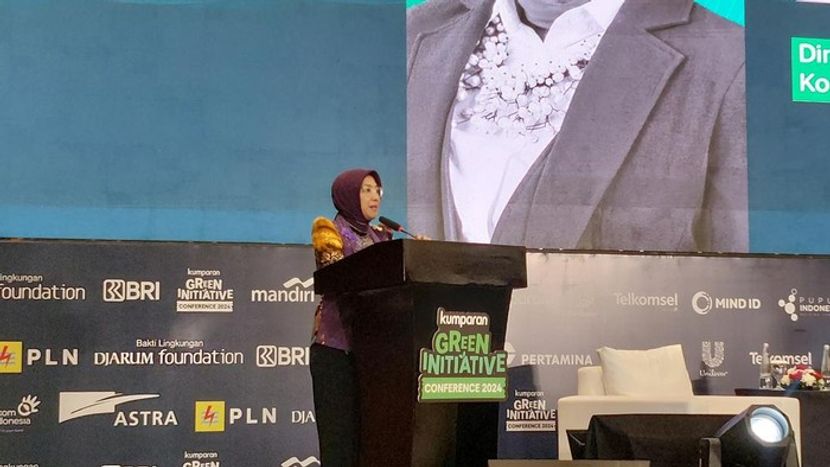
 The Ministry of Energy and Mineral Resources (ESDM) has revealed Indonesia's plan to develop ocean energy power plants, targeting a capacity of 2 gigawatts (GW) by 2060.The Director General of New, Renewable Energy and Energy Conservation (EBTKE) at the Ministry of Energy and Mineral Resources expressed this during the Indonesia Environmental Challenge Solutions event. The National Electricity General Plan (RUKN) and the Electricity Supply Business Plan (RUPTL) set targets for utilizing ocean energy power plants. Under the net-zero scenario, wind usage increases, followed by ocean energy, which will contribute 2 GW by 2060. The development plan for PLTGL is currently conducting data research in collaboration with the international community, which is beneficial for building wave power plants (PLTGL) and ocean current power plants (PLTAL).
In fact, they are cooperating with the international community in these waters to utilize data from waves, currents, and deep seas. Furthermore, the Ministry of Energy and Mineral Resources noted that the total utilization of marine renewable energy is still 0%, despite the potential of this ocean energy power plant reaching 63 GW. Meanwhile, Indonesia's new renewable energy (EBT) utilization is only 0.3%, or about 13.7 GW, out of a total potential of 3.4 terawatts (TW). To optimize renewable energy, investments of USD 15.9 billion are needed by 2030, with installed capacity reaching 7.66 GW. Currently, only 0.3% of the 3.4 TW potential of NRE is utilized, and even here, the utilization level of ocean energy remains at 0%.
The Ministry of Energy and Mineral Resources (ESDM) has revealed Indonesia's plan to develop ocean energy power plants, targeting a capacity of 2 gigawatts (GW) by 2060.The Director General of New, Renewable Energy and Energy Conservation (EBTKE) at the Ministry of Energy and Mineral Resources expressed this during the Indonesia Environmental Challenge Solutions event. The National Electricity General Plan (RUKN) and the Electricity Supply Business Plan (RUPTL) set targets for utilizing ocean energy power plants. Under the net-zero scenario, wind usage increases, followed by ocean energy, which will contribute 2 GW by 2060. The development plan for PLTGL is currently conducting data research in collaboration with the international community, which is beneficial for building wave power plants (PLTGL) and ocean current power plants (PLTAL).
In fact, they are cooperating with the international community in these waters to utilize data from waves, currents, and deep seas. Furthermore, the Ministry of Energy and Mineral Resources noted that the total utilization of marine renewable energy is still 0%, despite the potential of this ocean energy power plant reaching 63 GW. Meanwhile, Indonesia's new renewable energy (EBT) utilization is only 0.3%, or about 13.7 GW, out of a total potential of 3.4 terawatts (TW). To optimize renewable energy, investments of USD 15.9 billion are needed by 2030, with installed capacity reaching 7.66 GW. Currently, only 0.3% of the 3.4 TW potential of NRE is utilized, and even here, the utilization level of ocean energy remains at 0%.
Indonesia Plans to Build Ocean Energy Power Plants
www.indoent.com
2024-10-07
The Ministry of Energy and Mineral Resources (ESDM) has revealed Indonesia's plan to develop ocean energy power plants, targeting a capacity of 2 gigawatts (GW) by 2060. The Director General of New, Renewable Energy and Energy Conservation (EBTKE) at the Ministry of Energy and Mineral Resources expressed this during the Indonesia Environmental Challenge Solutions event. The National Electricity General Plan (RUKN) and the Electricity Supply Business Plan (RUPTL) set targets for utilizing ocean energy power plants. Under the net-zero scenario, wind usage increases, followed by ocean energy, which will contribute 2 GW by 2060.
The Ministry of Energy and Mineral Resources (ESDM) has revealed Indonesia's plan to develop ocean energy power plants, targeting a capacity of 2 gigawatts (GW) by 2060.The Director General of New, Renewable Energy and Energy Conservation (EBTKE) at the Ministry of Energy and Mineral Resources expressed this during the Indonesia Environmental Challenge Solutions event. The National Electricity General Plan (RUKN) and the Electricity Supply Business Plan (RUPTL) set targets for utilizing ocean energy power plants. Under the net-zero scenario, wind usage increases, followed by ocean energy, which will contribute 2 GW by 2060. The development plan for PLTGL is currently conducting data research in collaboration with the international community, which is beneficial for building wave power plants (PLTGL) and ocean current power plants (PLTAL).
In fact, they are cooperating with the international community in these waters to utilize data from waves, currents, and deep seas. Furthermore, the Ministry of Energy and Mineral Resources noted that the total utilization of marine renewable energy is still 0%, despite the potential of this ocean energy power plant reaching 63 GW. Meanwhile, Indonesia's new renewable energy (EBT) utilization is only 0.3%, or about 13.7 GW, out of a total potential of 3.4 terawatts (TW). To optimize renewable energy, investments of USD 15.9 billion are needed by 2030, with installed capacity reaching 7.66 GW. Currently, only 0.3% of the 3.4 TW potential of NRE is utilized, and even here, the utilization level of ocean energy remains at 0%.
Tags
Industry News
Share to
Related Reading
 Industry Flash
Cheap Chinese Plastics Impact Indonesia's Petrochemical Industry, Association Calls for Protection
2026-09-03 Industry News
Investment Heat in Two Key Industrial Parks in Central Java Continues to Rise
2026-08-31 Industry News