
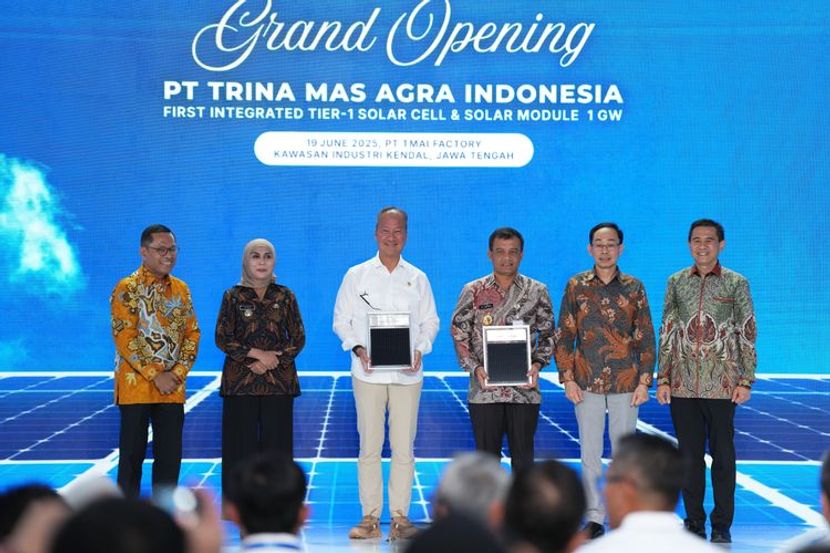
 The Minister of Industry recently inaugurated the solar panel factory of PT Trina Mas Agra Indonesia (TMAI) in the Kendal Special Economic Zone, Central Java. The factory, with an investment of over IDR 1.5 trillion, has an initial operating capacity of 1 GW per year, producing approximately 1.4 million solar panels annually. It adopts the latest i-Topcon technology with 23% efficiency, and each solar panel can achieve a maximum output of 720 Wp. The panels produced are among the largest in the world, and the factory is Indonesia's first integrated facility combining cell and module production. After the factory's operation, Indonesia's dependence on imported solar cell modules and cells from China, Malaysia, Vietnam and other countries will be reduced. This will help foster a local solar panel industry ecosystem, including the use of components from local supporting industries, accelerate the domestic application of solar cells, and develop upstream products such as wafers, ingots, and polysilicon smelting in the future. The factory employs 640 workers with expertise in the solar panel field, who have received training in China, reflecting the company's commitment to employee skills development. The Minister emphasized the urgency of localizing silica sand; Indonesia has silica sand reserves of over 330 million tons, with a potential of 25 billion tons. Processing silica sand into wafers can add value up to 25 times, and the government will prioritize developing the industrial chain and supply chain from upstream to downstream. The government is driving TMAI to achieve an initial local component ratio (TKDN) target of 41%, while the Ministry of Industry is preparing a new TKDN calculation method to speed up processes, simplify mechanisms, and reduce certification costs. This reform will provide broader space for new investments and domestic companies. The Minister believes that this factory is an important pillar of the domestic industrial sector, and its high-tech panel production is not only a technology supplier but also a catalyst for creating an independent national solar energy ecosystem. TMAI's Deputy CEO stated that the factory's existence is expected to bring a positive impact on Indonesia's clean energy goals and help reduce the country's dependence on imported energy industry components.
Indonesia's Largest Solar Panel Factory Officially Commences Production
www.indoent.com
2025-06-20
The Minister of Industry recently inaugurated the solar panel factory of PT Trina Mas Agra Indonesia (TMAI) in the Kendal Special Economic Zone, Central Java. The factory, with an investment of over IDR 1.5 trillion, has an initial operating capacity of 1 GW per year, producing approximately 1.4 million solar panels annually. It adopts the latest i-Topcon technology with 23% efficiency, and each solar panel can achieve a maximum output of 720 Wp. The panels produced are among the largest in the world, and the factory is Indonesia's first integrated facility combining cell and module production.
The Minister of Industry recently inaugurated the solar panel factory of PT Trina Mas Agra Indonesia (TMAI) in the Kendal Special Economic Zone, Central Java. The factory, with an investment of over IDR 1.5 trillion, has an initial operating capacity of 1 GW per year, producing approximately 1.4 million solar panels annually. It adopts the latest i-Topcon technology with 23% efficiency, and each solar panel can achieve a maximum output of 720 Wp. The panels produced are among the largest in the world, and the factory is Indonesia's first integrated facility combining cell and module production. After the factory's operation, Indonesia's dependence on imported solar cell modules and cells from China, Malaysia, Vietnam and other countries will be reduced. This will help foster a local solar panel industry ecosystem, including the use of components from local supporting industries, accelerate the domestic application of solar cells, and develop upstream products such as wafers, ingots, and polysilicon smelting in the future. The factory employs 640 workers with expertise in the solar panel field, who have received training in China, reflecting the company's commitment to employee skills development. The Minister emphasized the urgency of localizing silica sand; Indonesia has silica sand reserves of over 330 million tons, with a potential of 25 billion tons. Processing silica sand into wafers can add value up to 25 times, and the government will prioritize developing the industrial chain and supply chain from upstream to downstream. The government is driving TMAI to achieve an initial local component ratio (TKDN) target of 41%, while the Ministry of Industry is preparing a new TKDN calculation method to speed up processes, simplify mechanisms, and reduce certification costs. This reform will provide broader space for new investments and domestic companies. The Minister believes that this factory is an important pillar of the domestic industrial sector, and its high-tech panel production is not only a technology supplier but also a catalyst for creating an independent national solar energy ecosystem. TMAI's Deputy CEO stated that the factory's existence is expected to bring a positive impact on Indonesia's clean energy goals and help reduce the country's dependence on imported energy industry components.
Tags
Industry News
Share to
Related Reading
 Industry Flash
Cheap Chinese Plastics Impact Indonesia's Petrochemical Industry, Association Calls for Protection
2026-09-03 Industry News
Investment Heat in Two Key Industrial Parks in Central Java Continues to Rise
2026-08-31 Industry News