
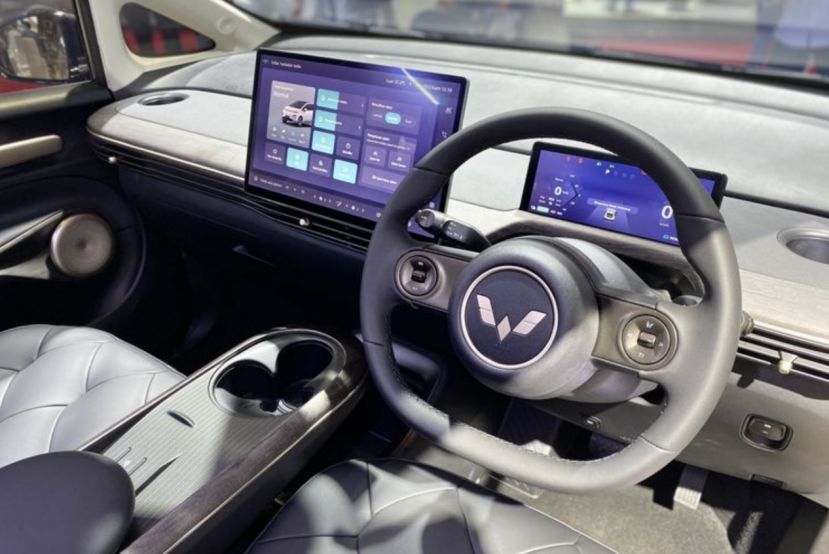
 A Jakarta owner who purchased a Wuling Cloud EV in October 2024 has driven over 11,583 km, mainly for daily city commutes and weekend family trips.
He believes it is more energy-efficient than a fuel car, with monthly electricity costs of around IDR 300,000 to IDR 400,000, far lower than the previous fuel cost of over IDR 1 million; annual tax is approximately IDR 343,000, including IDR 143,000 for SWDKLLJ and IDR 200,000 for STNK administration fees; it is quite practical for daily city driving. However, this model uses an automatic parking brake instead of a mechanical hand lever, which requires adaptation; if the vehicle rolls backward on a slope, you need to brake to a stop before moving forward, which is less convenient than a fuel car.
Additionally, the suspension is quite stiff, resulting in reduced comfort when driving on uneven roads or gravel; the steering wheel is too light, making it less stable at high speeds and feeling floaty, though it is acceptable for city driving; the voice command to open the trunk is considered less practical than a regular button by the owner; fast charging uses the GB/T interface, which is incompatible with the CCS2 standard used by most charging stations in Indonesia, causing inconvenience on long trips. This model, with its low operating costs and suitability for city commuting, is an attractive option for Indonesian consumers considering an electric vehicle, but there are still areas that need improvement.
A Jakarta owner who purchased a Wuling Cloud EV in October 2024 has driven over 11,583 km, mainly for daily city commutes and weekend family trips.
He believes it is more energy-efficient than a fuel car, with monthly electricity costs of around IDR 300,000 to IDR 400,000, far lower than the previous fuel cost of over IDR 1 million; annual tax is approximately IDR 343,000, including IDR 143,000 for SWDKLLJ and IDR 200,000 for STNK administration fees; it is quite practical for daily city driving. However, this model uses an automatic parking brake instead of a mechanical hand lever, which requires adaptation; if the vehicle rolls backward on a slope, you need to brake to a stop before moving forward, which is less convenient than a fuel car.
Additionally, the suspension is quite stiff, resulting in reduced comfort when driving on uneven roads or gravel; the steering wheel is too light, making it less stable at high speeds and feeling floaty, though it is acceptable for city driving; the voice command to open the trunk is considered less practical than a regular button by the owner; fast charging uses the GB/T interface, which is incompatible with the CCS2 standard used by most charging stations in Indonesia, causing inconvenience on long trips. This model, with its low operating costs and suitability for city commuting, is an attractive option for Indonesian consumers considering an electric vehicle, but there are still areas that need improvement.
Real Owner Experience of Wuling Cloud EV in Indonesia
www.indoent.com
2025-08-23
A Jakarta owner who purchased a Wuling Cloud EV in October 2024 has driven over 11,583 km, mainly for daily city commutes and weekend family trips. He believes it is more energy-efficient than a fuel car, with monthly electricity costs of around IDR 300,000 to IDR 400,000, far lower than the previous fuel cost of over IDR 1 million; annual tax is approximately IDR 343,000, including IDR 143,000 for SWDKLLJ and IDR 200,000 for STNK administration fees; it is quite practical for daily city driving. However, this model uses an automatic parking brake instead of a mechanical hand lever, which requires adaptation; if the vehicle rolls backward on a slope, you need to brake to a stop before moving forward, which is less convenient than a fuel car.
A Jakarta owner who purchased a Wuling Cloud EV in October 2024 has driven over 11,583 km, mainly for daily city commutes and weekend family trips.
He believes it is more energy-efficient than a fuel car, with monthly electricity costs of around IDR 300,000 to IDR 400,000, far lower than the previous fuel cost of over IDR 1 million; annual tax is approximately IDR 343,000, including IDR 143,000 for SWDKLLJ and IDR 200,000 for STNK administration fees; it is quite practical for daily city driving. However, this model uses an automatic parking brake instead of a mechanical hand lever, which requires adaptation; if the vehicle rolls backward on a slope, you need to brake to a stop before moving forward, which is less convenient than a fuel car.
Additionally, the suspension is quite stiff, resulting in reduced comfort when driving on uneven roads or gravel; the steering wheel is too light, making it less stable at high speeds and feeling floaty, though it is acceptable for city driving; the voice command to open the trunk is considered less practical than a regular button by the owner; fast charging uses the GB/T interface, which is incompatible with the CCS2 standard used by most charging stations in Indonesia, causing inconvenience on long trips. This model, with its low operating costs and suitability for city commuting, is an attractive option for Indonesian consumers considering an electric vehicle, but there are still areas that need improvement.
Share to
Related Reading
 China Investment News
China's AiMOGA Humanoid Robot Obtains Three International Certifications
2026-09-07 China Investment News
Only Three Chinese Automakers Have Independently Built Factories in Indonesia
2026-09-05 Chinese Investment News