
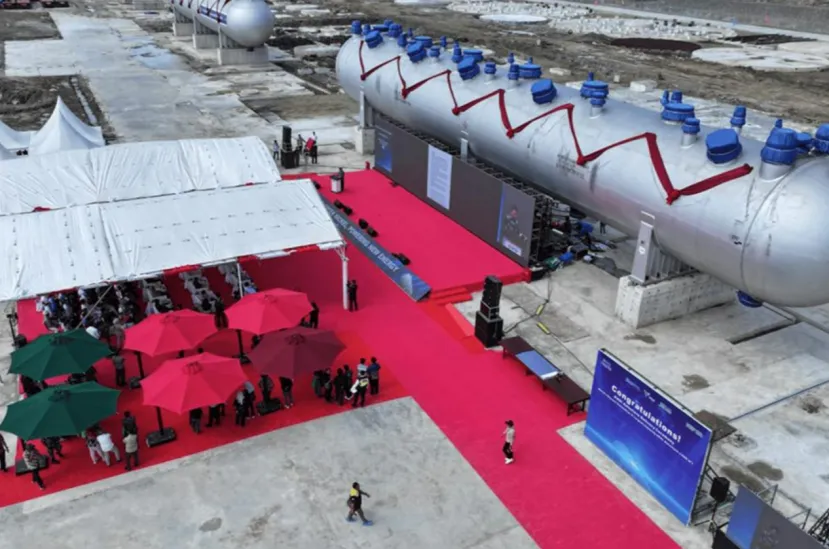
Against the backdrop of rapid global electric vehicle industry development and increasing geopolitical trade uncertainties, transnational industrial collaboration has become the core key to the battery industry chain. The Indonesia Bahodopi Nickel Smelting (BNSI) project, jointly built by PT Vale Indonesia, GEM Co., Ltd. from China, and EcoPro from South Korea, has created a new model of international cooperation that complements resources, technology, and markets. Recently, the project successfully completed the installation of a world's largest-capacity High Pressure Acid Leach (HPAL) autoclave with a volume of 1,268 cubic meters, marking a critical stage in the project's construction and effectively solidifying Indonesia's core position in the global new energy mineral supply chain. This cooperation brings together the core industrial advantages of Indonesia, China, and South Korea, forming a complete closed-loop industrial chain.
Leveraging its local advantages, Indonesia has a world-class nickel ore resource base with a 118,000-hectare concession area, combined with a well-developed downstream mineral processing support policy, providing stable raw material assurance for the project. GEM from China provides new-generation HPAL core technology that can efficiently process laterite nickel ore to produce mixed nickel hydroxide, nickel sulfate, and battery precursor materials, with advantages of high efficiency, energy saving, low carbon, and environmental friendliness, helping the project build a circular economy green industrial park. EcoPro from South Korea contributes advanced cathode material research and development and manufacturing technology, while also connecting the global battery industry sales network. This project is a national strategic project of Indonesia, with a total investment of US$1.845 billion (equivalent to IDR 29 trillion), and is planned to produce 90,000 tons of nickel metal equivalent MHP products annually.
The project is expected to be completed by the end of 2026 and commence formal production in the first quarter of 2027. After production, it will create US$1.5 billion in annual export value, provide over 5,000 local jobs, and its annual raw material output can meet the production needs of 3 million new energy vehicles. Products will mainly supply major markets such as South Korea, Europe, and the United States. In addition, the project is built according to low-carbon park standards, in line with Indonesia's 2060 net-zero emission target, and relies on a circular economy model to create a world-class green industrial park. The South Korean ambassador stated that amid rising geopolitical conflicts and trade protectionism, the trilateral transnational collaboration has built a stable green supply chain, breaking away from the limitations of single resource or technology competition, providing a new model for global new energy industry cooperation, and also promoting the upgrading of Indonesia's nickel downstream industry, helping it become deeply embedded in the core global new energy industry chain.


