
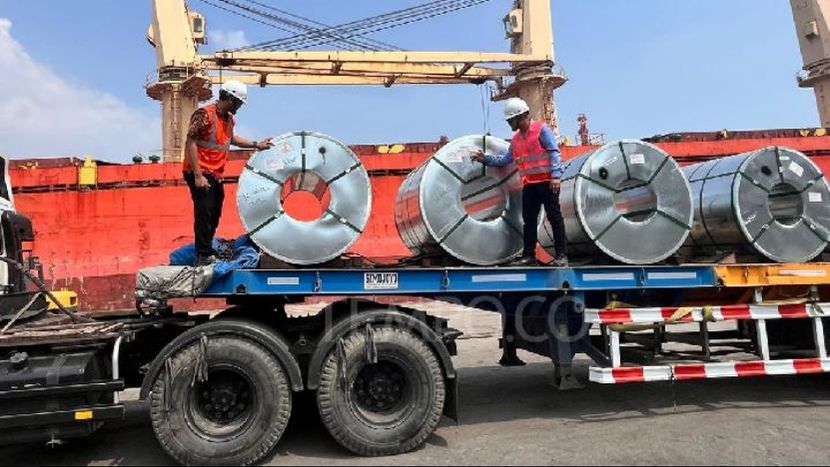
 PT AM/NS Indonesia recently held a ceremony at Tanjung Priok Port to export 10,000 tons of galvanized steel to the US, the highest export volume in nearly 20 years, worth US$10 million. An official from the Ministry of Industry stated that the steel industry shows a positive growth trend with increasing exports, especially entering competitive markets like the US, proving that Indonesian steel quality is internationally recognized and globally competitive. The Indonesian steel industry faces global competition mainly from countries such as China, Vietnam, Japan, and South Korea. Meanwhile, inadequate regulation of non-standard steel imports affects industrial development. To enhance the competitiveness of the steel industry, the government has formulated multiple strategic policies, including implementing major tracking measures, enforcing Indonesian National Standards (SNI) to ensure domestic steel product quality, and providing fiscal facilities such as tax reductions, tax holidays, and simplifying raw material import procedures through master lists. These policies will be continuously evaluated to improve effectiveness. The company's current main markets are the US and Canada, with a target of exporting 5,000-6,000 tons per month to the US and 3,000-4,000 tons per quarter to Canada. The company also plans to explore new markets such as Europe, Malaysia, and Australia.
Indonesian Steel Exports to the US and Canadian Markets
www.indoent.com
2025-05-07
PT AM/NS Indonesia recently held a ceremony at Tanjung Priok Port to export 10,000 tons of galvanized steel to the US, the highest export volume in nearly 20 years, worth US$10 million. An official from the Ministry of Industry stated that the steel industry shows a positive growth trend with increasing exports, especially entering competitive markets like the US, proving that Indonesian steel quality is internationally recognized and globally competitive. The Indonesian steel industry faces global competition mainly from countries such as China, Vietnam, Japan, and South Korea. Meanwhile, inadequate regulation of non-standard steel imports affects industrial development. To enhance the competitiveness of the steel industry, the government has formulated multiple
PT AM/NS Indonesia recently held a ceremony at Tanjung Priok Port to export 10,000 tons of galvanized steel to the US, the highest export volume in nearly 20 years, worth US$10 million. An official from the Ministry of Industry stated that the steel industry shows a positive growth trend with increasing exports, especially entering competitive markets like the US, proving that Indonesian steel quality is internationally recognized and globally competitive. The Indonesian steel industry faces global competition mainly from countries such as China, Vietnam, Japan, and South Korea. Meanwhile, inadequate regulation of non-standard steel imports affects industrial development. To enhance the competitiveness of the steel industry, the government has formulated multiple strategic policies, including implementing major tracking measures, enforcing Indonesian National Standards (SNI) to ensure domestic steel product quality, and providing fiscal facilities such as tax reductions, tax holidays, and simplifying raw material import procedures through master lists. These policies will be continuously evaluated to improve effectiveness. The company's current main markets are the US and Canada, with a target of exporting 5,000-6,000 tons per month to the US and 3,000-4,000 tons per quarter to Canada. The company also plans to explore new markets such as Europe, Malaysia, and Australia.
Tags
Industry News
Share to
Related Reading
 Industry Flash
Cheap Chinese Plastics Impact Indonesia's Petrochemical Industry, Association Calls for Protection
2026-09-03 Industry News
Investment Heat in Two Key Industrial Parks in Central Java Continues to Rise
2026-08-31 Industry News