
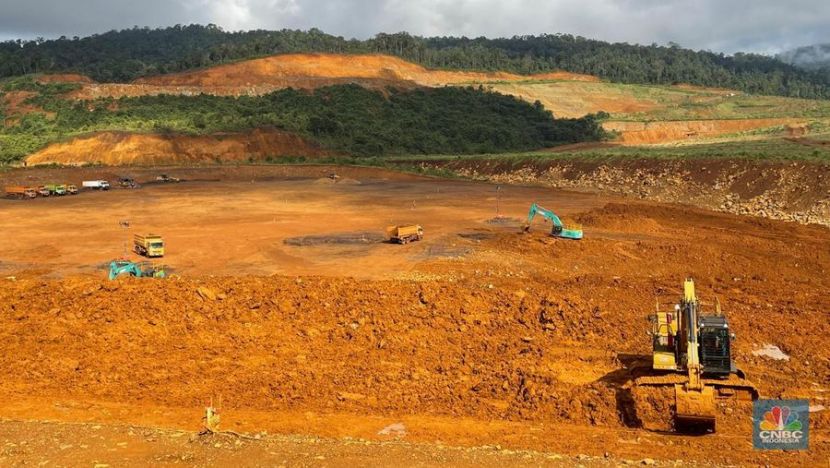
 Data from the U.S. Geological Survey shows that 43% of global nickel reserves are in Indonesia, a fact confirmed by the Minister of Energy and Mineral Resources. According to the 2025 Indonesia Mineral and Coal Resource and Reserve Balance Report (data updated to December 2024) published by the Indonesian Geological Agency, Indonesia's nickel ore reserves in 2024 stood at 5.913 billion tons, comprising 3.818 billion tons of inferred reserves and 2.095 billion tons of proven reserves. Based on the estimated annual nickel ore production of 173 million tons in 2024, Indonesia's nickel reserves are expected to last for another 34 years. Indonesia stopped exporting nickel ore in 2020 to promote downstream development of nickel resources. In 2024, Indonesia's nickel downstream industry export value reached US$33.9 billion (approximately IDR 555.51 trillion), a significant increase from US$3.3 billion (approximately IDR 54.07 trillion) in 2017. Indonesia is promoting the use of nickel for electric vehicle battery production, where low-grade nickel (limonite) is more efficient in battery production, while serpentine requires further technical improvement and is more costly. The success of Indonesia's nickel industry has triggered global business competition while also facing negative publicity from other countries regarding the perceived lack of environmental friendliness in its natural resource management.
34% of Global Nickel Reserves Located in Indonesia
www.indoent.com
2025-08-07
Data from the U.S. Geological Survey shows that 43% of global nickel reserves are in Indonesia, a fact confirmed by the Minister of Energy and Mineral Resources. According to the 2025 Indonesia Mineral and Coal Resource and Reserve Balance Report (data updated to December 2024) published by the Indonesian Geological Agency, Indonesia's nickel ore reserves in 2024 stood at 5.913 billion tons, comprising 3.818 billion tons of inferred reserves and 2.095 billion tons of proven reserves. Based on the estimated annual nickel ore production of 173 million tons in 2024, Indonesia's nickel reserves are expected to last for another 34 years. Indonesia stopped exporting nickel ore in 2020
Data from the U.S. Geological Survey shows that 43% of global nickel reserves are in Indonesia, a fact confirmed by the Minister of Energy and Mineral Resources. According to the 2025 Indonesia Mineral and Coal Resource and Reserve Balance Report (data updated to December 2024) published by the Indonesian Geological Agency, Indonesia's nickel ore reserves in 2024 stood at 5.913 billion tons, comprising 3.818 billion tons of inferred reserves and 2.095 billion tons of proven reserves. Based on the estimated annual nickel ore production of 173 million tons in 2024, Indonesia's nickel reserves are expected to last for another 34 years. Indonesia stopped exporting nickel ore in 2020 to promote downstream development of nickel resources. In 2024, Indonesia's nickel downstream industry export value reached US$33.9 billion (approximately IDR 555.51 trillion), a significant increase from US$3.3 billion (approximately IDR 54.07 trillion) in 2017. Indonesia is promoting the use of nickel for electric vehicle battery production, where low-grade nickel (limonite) is more efficient in battery production, while serpentine requires further technical improvement and is more costly. The success of Indonesia's nickel industry has triggered global business competition while also facing negative publicity from other countries regarding the perceived lack of environmental friendliness in its natural resource management.
Tags
Industry News
Share to
Related Reading
 Industry Flash
Cheap Chinese Plastics Impact Indonesia's Petrochemical Industry, Association Calls for Protection
2026-09-03 Industry News
Investment Heat in Two Key Industrial Parks in Central Java Continues to Rise
2026-08-31 Industry News