
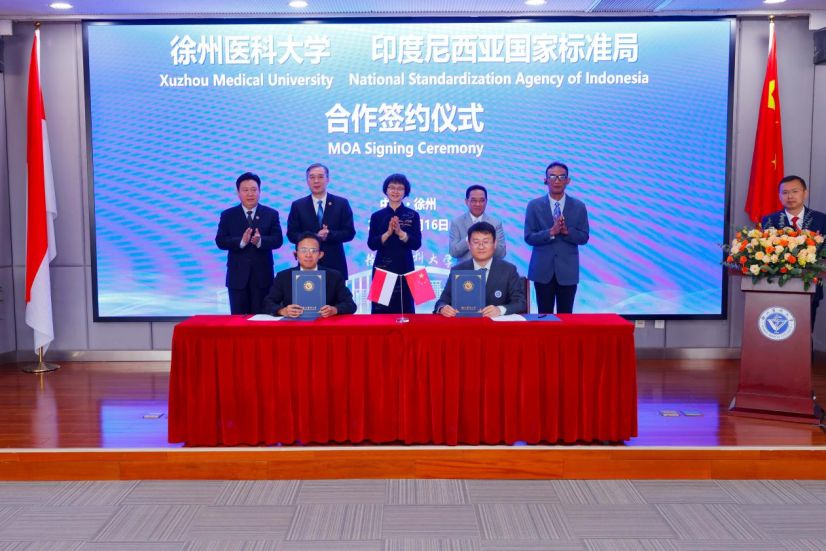
 Xuzhou Medical University and the National Standardization Agency of Indonesia (BSN) signed a cooperation agreement in Xuzhou to jointly establish the China-Indonesia Joint Laboratory for Digital Medicine and Active Health. The Deputy Minister of Health of Indonesia, Secretary-General of the Indonesian Standardization Agency, Chairman of the Indonesian Hospital Association, as well as representatives from the Jiangsu Provincial Department of Education and Xuzhou Medical University attended the signing ceremony. The university's Party Secretary stated that the university will use its self-developed Medical Network and System Services (MNSS) platform as the digital foundation, turning the joint laboratory into a regional industrial internationalization accelerator, promoting the export of medical devices and health services from Xuzhou and the Huaihai Economic Zone, and providing full-element support to build a high-quality research ecosystem.
A second-level inspector from the Jiangsu Provincial Department of Education praised the university's exploratory achievements, expressing hope that the laboratory will become a benchmark for international research cooperation, produce original results in areas such as mutual recognition of medical standards, establish talent exchange mechanisms, and accelerate the transformation of scientific research outcomes. The Deputy Minister pointed out that the laboratory will serve as a platform for formulating digital medical standards, supporting the implementation of Indonesia's national smart hospital standards. The Secretary-General noted that the laboratory aligns with Indonesia's health transformation and the "Golden Indonesia 2045" vision, contributing to smart healthcare development.
Representatives from Xuzhou Medical University signed a memorandum of cooperation with relevant Indonesian parties. The Indonesian delegation also visited the university's affiliated hospital and the future industry science and technology park. This cooperation marks a shift from standard alignment to on-the-ground implementation in China-Indonesia collaboration, representing a key step in the university's education internationalization strategy. In the future, the university will deepen cooperation with countries along the "Belt and Road" to help build a global community of health for all.
Xuzhou Medical University and the National Standardization Agency of Indonesia (BSN) signed a cooperation agreement in Xuzhou to jointly establish the China-Indonesia Joint Laboratory for Digital Medicine and Active Health. The Deputy Minister of Health of Indonesia, Secretary-General of the Indonesian Standardization Agency, Chairman of the Indonesian Hospital Association, as well as representatives from the Jiangsu Provincial Department of Education and Xuzhou Medical University attended the signing ceremony. The university's Party Secretary stated that the university will use its self-developed Medical Network and System Services (MNSS) platform as the digital foundation, turning the joint laboratory into a regional industrial internationalization accelerator, promoting the export of medical devices and health services from Xuzhou and the Huaihai Economic Zone, and providing full-element support to build a high-quality research ecosystem.
A second-level inspector from the Jiangsu Provincial Department of Education praised the university's exploratory achievements, expressing hope that the laboratory will become a benchmark for international research cooperation, produce original results in areas such as mutual recognition of medical standards, establish talent exchange mechanisms, and accelerate the transformation of scientific research outcomes. The Deputy Minister pointed out that the laboratory will serve as a platform for formulating digital medical standards, supporting the implementation of Indonesia's national smart hospital standards. The Secretary-General noted that the laboratory aligns with Indonesia's health transformation and the "Golden Indonesia 2045" vision, contributing to smart healthcare development.
Representatives from Xuzhou Medical University signed a memorandum of cooperation with relevant Indonesian parties. The Indonesian delegation also visited the university's affiliated hospital and the future industry science and technology park. This cooperation marks a shift from standard alignment to on-the-ground implementation in China-Indonesia collaboration, representing a key step in the university's education internationalization strategy. In the future, the university will deepen cooperation with countries along the "Belt and Road" to help build a global community of health for all.
Chinese University and Indonesian National Standardization Agency Jointly Establish Laboratory
www.indoent.com
2026-01-20
Xuzhou Medical University and the National Standardization Agency of Indonesia (BSN) signed a cooperation agreement in Xuzhou to jointly establish the China-Indonesia Joint Laboratory for Digital Medicine and Active Health. The Deputy Minister of Health of Indonesia, Secretary-General of the Indonesian Standardization Agency, Chairman of the Indonesian Hospital Association, as well as representatives from the Jiangsu Provincial Department of Education and Xuzhou Medical University attended the signing ceremony. The university's Party Secretary stated that the university will use its self-developed Medical Network and System Services (MNSS) platform as the digital foundation, turning the joint laboratory into a regional industrial internationalization accelerator, promoting the export of medical devices and health services from Xuzhou and the Huaihai Economic Zone, and providing full-element support to build a high-quality research ecosystem.
Xuzhou Medical University and the National Standardization Agency of Indonesia (BSN) signed a cooperation agreement in Xuzhou to jointly establish the China-Indonesia Joint Laboratory for Digital Medicine and Active Health. The Deputy Minister of Health of Indonesia, Secretary-General of the Indonesian Standardization Agency, Chairman of the Indonesian Hospital Association, as well as representatives from the Jiangsu Provincial Department of Education and Xuzhou Medical University attended the signing ceremony. The university's Party Secretary stated that the university will use its self-developed Medical Network and System Services (MNSS) platform as the digital foundation, turning the joint laboratory into a regional industrial internationalization accelerator, promoting the export of medical devices and health services from Xuzhou and the Huaihai Economic Zone, and providing full-element support to build a high-quality research ecosystem.
A second-level inspector from the Jiangsu Provincial Department of Education praised the university's exploratory achievements, expressing hope that the laboratory will become a benchmark for international research cooperation, produce original results in areas such as mutual recognition of medical standards, establish talent exchange mechanisms, and accelerate the transformation of scientific research outcomes. The Deputy Minister pointed out that the laboratory will serve as a platform for formulating digital medical standards, supporting the implementation of Indonesia's national smart hospital standards. The Secretary-General noted that the laboratory aligns with Indonesia's health transformation and the "Golden Indonesia 2045" vision, contributing to smart healthcare development.
Representatives from Xuzhou Medical University signed a memorandum of cooperation with relevant Indonesian parties. The Indonesian delegation also visited the university's affiliated hospital and the future industry science and technology park. This cooperation marks a shift from standard alignment to on-the-ground implementation in China-Indonesia collaboration, representing a key step in the university's education internationalization strategy. In the future, the university will deepen cooperation with countries along the "Belt and Road" to help build a global community of health for all.
Tags
Social Dynamics
Share to


