
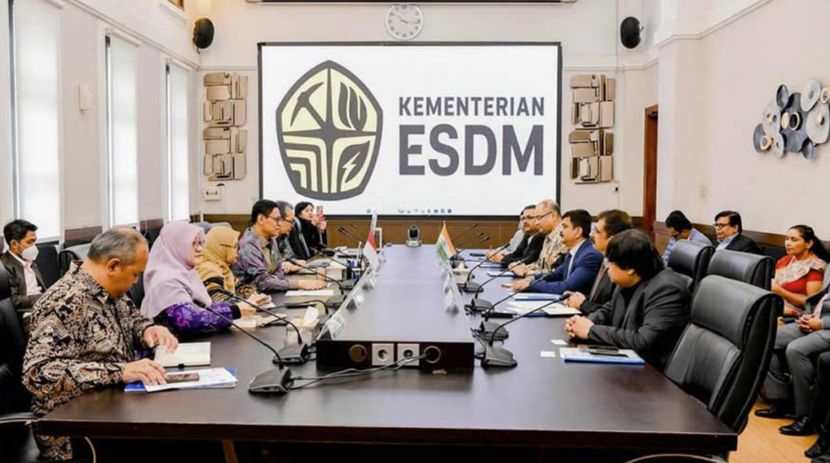
 The Ministry of Energy and Mineral Resources (ESDM) recently held bilateral talks with the Ministry of Steel, Government of India, focusing on investment opportunities and strategic cooperation between the two countries. The Deputy Minister of Energy stated that the cooperation mainly focuses on critical mineral development and supporting the construction of steel production facilities in Indonesia to strengthen Indonesia's energy security and promote sustainable investment. He had in-depth discussions with the Secretary of the Ministry of Steel of India on strategic collaboration, expressing hope that this meeting would become an important step in deepening Indonesia-India cooperation.
Notably, India recently signed a critical mineral cooperation framework agreement with Brazil on February 21 (Saturday), and the two sides will cooperate closely in the field of mineral processing to cope with global supply chain fluctuations. Brazil, with the world's second-largest rare earth metal reserves, can provide alternative supply sources for India, reducing dependence on China and ensuring raw material security for key sectors such as electronics, clean energy, and national defense. Before this agreement, India also joined the US-led "Pax Silica" initiative to jointly build robust supply chains for semiconductors, artificial intelligence, and critical minerals.
On the other hand, Indonesia and the United States have also confirmed cooperation on the management of the entire industry chain of critical minerals (including rare earth elements, REE) from upstream to downstream. This cooperation is written into the terms of the reciprocal tariff agreement signed by President Prabowo and US President Donald Trump. A document released by the White House on February 19 local time clearly stated that Indonesia will remove restrictions on exports of US industrial goods, including critical minerals. The two countries will also accelerate cooperation in the development, processing, and downstream production of critical minerals based on commercial considerations.
Indonesia is committed to efficient collaboration with US companies in the field of rare earths and critical minerals, ensuring a safe and diverse supply chain, while providing stronger business certainty for companies involved in critical mineral mining to enhance production capacity and operational growth. In response, the Minister of Energy emphasized that although the US is allowed to process minerals in Indonesia, Indonesia will not export unprocessed critical mineral ores (including rare earths). The US side needs to build smelters locally for refining before exporting finished products to avoid misunderstandings.
The Ministry of Energy and Mineral Resources (ESDM) recently held bilateral talks with the Ministry of Steel, Government of India, focusing on investment opportunities and strategic cooperation between the two countries. The Deputy Minister of Energy stated that the cooperation mainly focuses on critical mineral development and supporting the construction of steel production facilities in Indonesia to strengthen Indonesia's energy security and promote sustainable investment. He had in-depth discussions with the Secretary of the Ministry of Steel of India on strategic collaboration, expressing hope that this meeting would become an important step in deepening Indonesia-India cooperation.
Notably, India recently signed a critical mineral cooperation framework agreement with Brazil on February 21 (Saturday), and the two sides will cooperate closely in the field of mineral processing to cope with global supply chain fluctuations. Brazil, with the world's second-largest rare earth metal reserves, can provide alternative supply sources for India, reducing dependence on China and ensuring raw material security for key sectors such as electronics, clean energy, and national defense. Before this agreement, India also joined the US-led "Pax Silica" initiative to jointly build robust supply chains for semiconductors, artificial intelligence, and critical minerals.
On the other hand, Indonesia and the United States have also confirmed cooperation on the management of the entire industry chain of critical minerals (including rare earth elements, REE) from upstream to downstream. This cooperation is written into the terms of the reciprocal tariff agreement signed by President Prabowo and US President Donald Trump. A document released by the White House on February 19 local time clearly stated that Indonesia will remove restrictions on exports of US industrial goods, including critical minerals. The two countries will also accelerate cooperation in the development, processing, and downstream production of critical minerals based on commercial considerations.
Indonesia is committed to efficient collaboration with US companies in the field of rare earths and critical minerals, ensuring a safe and diverse supply chain, while providing stronger business certainty for companies involved in critical mineral mining to enhance production capacity and operational growth. In response, the Minister of Energy emphasized that although the US is allowed to process minerals in Indonesia, Indonesia will not export unprocessed critical mineral ores (including rare earths). The US side needs to build smelters locally for refining before exporting finished products to avoid misunderstandings.
Indonesia and India Strengthen Cooperation in Mining and Steel Sectors
www.indoent.com
2026-03-01
The Ministry of Energy and Mineral Resources (ESDM) recently held bilateral talks with the Ministry of Steel, Government of India, focusing on investment opportunities and strategic cooperation between the two countries. The Deputy Minister of Energy stated that the cooperation mainly focuses on the development of critical minerals and supporting the construction of steel production facilities in Indonesia to strengthen Indonesia's energy security and promote sustainable investment. He had in-depth discussions with the Secretary of the Ministry of Steel of India on strategic collaboration, expressing hope that this meeting would become an important step in deepening Indonesia-India cooperation.
The Ministry of Energy and Mineral Resources (ESDM) recently held bilateral talks with the Ministry of Steel, Government of India, focusing on investment opportunities and strategic cooperation between the two countries. The Deputy Minister of Energy stated that the cooperation mainly focuses on critical mineral development and supporting the construction of steel production facilities in Indonesia to strengthen Indonesia's energy security and promote sustainable investment. He had in-depth discussions with the Secretary of the Ministry of Steel of India on strategic collaboration, expressing hope that this meeting would become an important step in deepening Indonesia-India cooperation.
Notably, India recently signed a critical mineral cooperation framework agreement with Brazil on February 21 (Saturday), and the two sides will cooperate closely in the field of mineral processing to cope with global supply chain fluctuations. Brazil, with the world's second-largest rare earth metal reserves, can provide alternative supply sources for India, reducing dependence on China and ensuring raw material security for key sectors such as electronics, clean energy, and national defense. Before this agreement, India also joined the US-led "Pax Silica" initiative to jointly build robust supply chains for semiconductors, artificial intelligence, and critical minerals.
On the other hand, Indonesia and the United States have also confirmed cooperation on the management of the entire industry chain of critical minerals (including rare earth elements, REE) from upstream to downstream. This cooperation is written into the terms of the reciprocal tariff agreement signed by President Prabowo and US President Donald Trump. A document released by the White House on February 19 local time clearly stated that Indonesia will remove restrictions on exports of US industrial goods, including critical minerals. The two countries will also accelerate cooperation in the development, processing, and downstream production of critical minerals based on commercial considerations.
Indonesia is committed to efficient collaboration with US companies in the field of rare earths and critical minerals, ensuring a safe and diverse supply chain, while providing stronger business certainty for companies involved in critical mineral mining to enhance production capacity and operational growth. In response, the Minister of Energy emphasized that although the US is allowed to process minerals in Indonesia, Indonesia will not export unprocessed critical mineral ores (including rare earths). The US side needs to build smelters locally for refining before exporting finished products to avoid misunderstandings.
Tags
Industry News
Share to
Related Reading
 Industry Flash
Cheap Chinese Plastics Impact Indonesia's Petrochemical Industry, Association Calls for Protection
2026-09-03 Industry News
Investment Heat in Two Key Industrial Parks in Central Java Continues to Rise
2026-08-31 Industry News