Detailed Introduction
The China Chamber of Commerce in Indonesia (CCCI) was established in 2005 as a non-profit, non-political chamber of commerce organization primarily composed of Chinese-invested enterprises operating in Indonesia.
The chamber mainly serves Chinese enterprises developing in Indonesia, including wholly-owned and joint ventures established by Chinese companies or Chinese individuals in Indonesia, as well as branch offices, representative offices, and other institutions set up by Chinese enterprises in Indonesia.
The chamber is committed to serving Chinese enterprises registered and operating in Indonesia, safeguarding their legitimate rights and interests, enhancing the traditional friendship between the Chinese and Indonesian peoples, promoting friendly cooperation and exchanges between enterprises of the two countries, and playing a bridging and bonding role between enterprises and gove ments, between enterprises, and between the Chinese and Indonesian business communities.
The chamber was formerly known as the Chinese Business Association in Indonesia. According to historical records, it was renamed the China Chamber of Commerce in Indonesia in 2010, and further renamed to its current name, China Chamber of Commerce in Indonesia (General), in 2015.
After more than two decades of development, the China Chamber of Commerce in Indonesia (General) has become one of the largest and most representative Chinese enterprise organizations in Indonesia.
Membership Scale
Currently, the China Chamber of Commerce in Indonesia (General) has:
Over 500 active member enterprises | 63 council member units
Member enterprises cover multiple sectors including energy and minerals, manufacturing, new energy, digital economy, green finance, infrastructure, engineering machinery, information and communication, transportation and logistics, trade and services, among others, including Fortune Global 500 companies, major Chinese state-owned enterprises, and leading enterprises in various industries.
Organizational Structure
The China Chamber of Commerce in Indonesia (General) has formed an organizational system consisting of the head chamber, industry sub-chambers, regional sub-chambers, clubs, and functional departments.
It currently has: 12 industry sub-chambers, 3 regional sub-chambers, 4 clubs, and 6 functional departments.
The 12 industry sub-chambers are: 1. New Energy Industry Sub-chamber
- Trade and Services Sub-chamber
- Energy and Commodities Sub-chamber
- Information and Communication Sub-chamber
- Mining and Metallurgy Sub-chamber
- E-commerce and Platform Economy Sub-chamber
- Electric Power and Automotive Sub-chamber
- Infrastructure Sub-chamber
- Engineering Machinery Sub-chamber
- Industrial Parks and Manufacturing Sub-chamber
- Agriculture, Forestry, Fishery and Consumer Goods Sub-chamber
- Transportation, Logistics and Finance Sub-chamber
3 Regional Sub-chambers
- Bali Sub-chamber
- Riau Sub-chamber
- Central Java Sub-chamber
Through industry sub-chambers, the chamber provides professional services to member enterprises in different industrial sectors, and through regional sub-chambers, it strengthens communication and collaboration among Chinese enterprises in different regions.
Chamber Gove ance
The chamber has established a gove ance system including the members' general meeting, the council, and routine working bodies.
The members' general meeting is responsible for reviewing and deciding on major matters of the chamber, while the council, as an important standing body, undertakes the decision-making, coordination, and management of major routine matters.
The chamber also has a secretariat and relevant professional functional departments responsible for member services, exte al liaison, industry coordination, policy research, information services, corporate compliance, and security assurance.
At present, the chamber has gradually formed an operational model of "overall coordination by the head chamber, professional services by industry sub-chambers, regional services by regional sub-chambers, and specialized support by functional departments."
Main Functions
The China Chamber of Commerce in Indonesia (General) currently works around:
"Promotion, Facilitation, Research, Guidance, Service, and Assurance"
Its work is carried out under these six functions and the twelve-character guideline.
The chamber has six main functional departments: Publicity Department, Exte al Relations Department, Research Department, Compliance Department, Information Service Department, and Security Assurance Department
The Publicity Department is mainly responsible for chamber publicity, member enterprise promotion, and dissemination of economic and trade information.
The Exte al Relations Department is mainly responsible for communication and liaison with Indonesian gove ment agencies, business associations, enterprises, and other institutions, promoting gove ment-enterprise exchanges and economic and trade cooperation.
The Research Department conducts research on Indonesia's macroeconomic conditions, industrial policies, investment environment, and industry development to provide references for member enterprises.
The Compliance Department focuses on assisting enterprises with localization and compliant operations, helping them understand relevant Indonesian laws, regulations, and operational requirements.
The Information Service Department is responsible for the compilation, sharing, and matching of information on policies, markets, industries, projects, and enterprise resources.
The Security Assurance Department mainly provides services related to enterprise production and operations, personnel safety, and risk prevention.
Chamber Services
The work of the China Chamber of Commerce in Indonesia (General) has gradually evolved from traditional enterprise liaison and member exchanges into a comprehensive service system for Chinese enterprises operating and developing in Indonesia.
It mainly includes the following aspects:
Gove ment-Enterprise Communication: Establishing communication channels between Chinese enterprises and Indonesian central and local gove ment departments, assisting enterprises in understanding policy changes, and reflecting issues and demands encountered during investment and operations.
Economic and Trade Promotion: Organizing and participating in investment promotion, business exchanges, project matchmaking, enterprise visits, and other activities to promote cooperation between Chinese enterprises and the Indonesian gove ment, enterprises, and business institutions.
Policy and Information Services: Conducting information compilation and policy promotion on Indonesia's investment environment, macroeconomic conditions, industrial policies, market access, labor, taxation, and related regulations.
Corporate Compliance: Providing support to member enterprises in laws and regulations, localized operations, labor employment, and corporate gove ance through policy training, thematic seminars, and cooperation with professional institutions.
Industry Coordination: Leveraging the 12 industry sub-chambers to strengthen information sharing and exchanges among Chinese enterprises in the same industry, and to study and coordinate common issues arising in industry development.
Security Assurance: Strengthening information sharing, risk alerts, and related coordination services regarding potential security risks faced by member enterprises and their employees in production, operations, and daily life in Indonesia.
Bridge Role Between Gove ment and Enterprises
One of the important roles of the China Chamber of Commerce in Indonesia (General) is to connect Chinese enterprises in Indonesia, the Chinese Embassy and Consulates in Indonesia, Indonesian gove ment departments, and the business communities of both countries.
The chamber has long maintained contact with relevant Indonesian gove ment departments and business institutions, and organizes Chinese enterprises to participate in policy exchanges, investment promotion, industry seminars, and business matchmaking events.
At the same time, the chamber also receives delegations from Chinese gove ment departments, trade promotion agencies, business associations, and enterprises, providing support for Chinese enterprises to understand Indonesia's investment environment, find partners, and expand into the local market.
Therefore, the chamber not only undertakes member management and enterprise exchange functions, but also assumes certain functions of gove ment-enterprise communication, policy feedback, industry coordination, and economic and trade promotion.
Chamber Influence
After more than two decades of development, the China Chamber of Commerce in Indonesia (General) has formed a network of Chinese enterprises covering multiple key industries and regions.
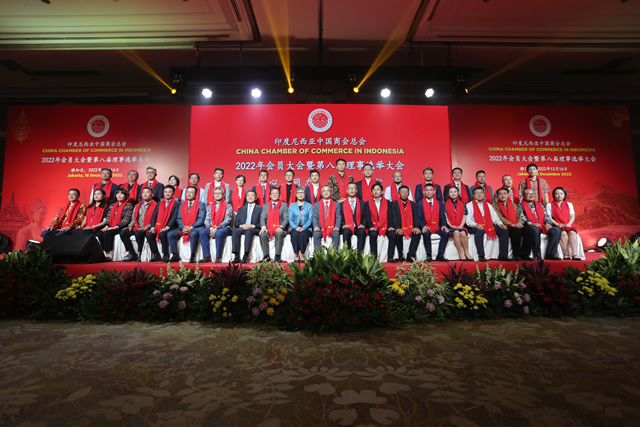
In January 2026, the chamber held a celebration for its 20th anniversary in Jakarta, attended by more than 600 people from Chinese and Indonesian gove ment departments, business communities, and chamber members.
The Chinese Embassy in Indonesia publicly stated that the China Chamber of Commerce in Indonesia (General) has developed into one of the largest, most representative, and most influential economic organizations of Chinese enterprises in Indonesia.
Judging from its membership composition, organizational system, and activities in recent years, the chamber has become an important service platform for Chinese enterprises to invest, operate, and cooperate in Indonesia.
Current Key Leaders
President: Sun Shangbin
Secretary-General: Huang Ruijin
Supervisor: Wang Lei
Sun Shangbin also serves as the President of Bank of China Jakarta Branch.