


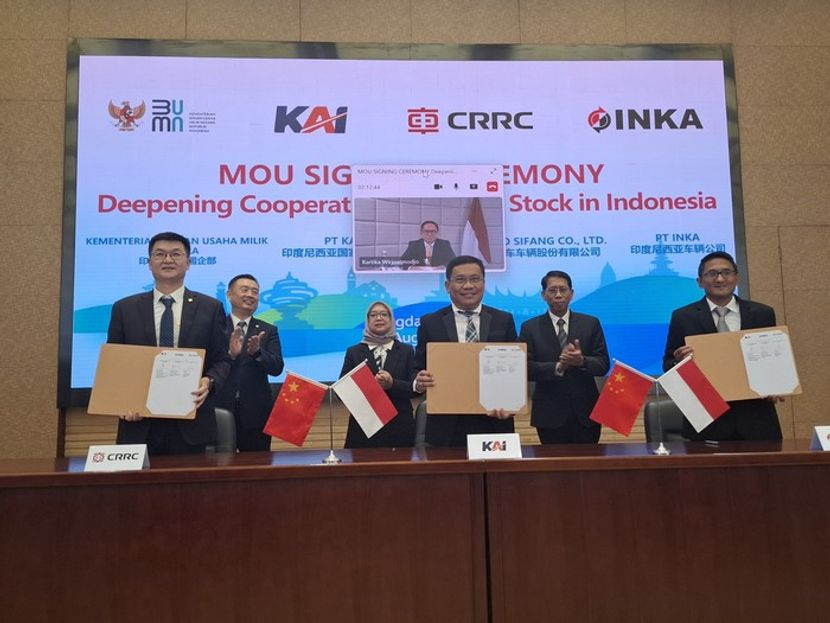
 PT Kereta Api Indonesia (Persero), PT Industri Kereta Api (Persero), and CRRC Qingdao Sifang Co., Ltd. have agreed to jointly collaborate on developing railway facilities in Indonesia. The memorandum of understanding (MoU) was signed in Qingdao, China by the Director of Strategic Planning and Facility Management of KAI, the Director of Development of PT INKA (Persero), and the President of CRRC Qingdao. The agenda was also witnessed by the Deputy Minister of State-Owned Enterprises (BUMN), the President Director of KAI, and the Chairman of CRRC Qingdao Sifang. The Indonesian side expressed its deepest gratitude to all Chinese parties, especially CRRC Qingdao Sifang, for their strong support and cooperation in the development of Indonesia's railway industry. The cooperation established with CRRC Qingdao Sifang covers various aspects, from KAI procurement in the form of KRL and KCIC, high-speed trains, to train maintenance and servicing. Not only that, CRRC Qingdao Sifang has also played a role in supporting transportation in the new capital region (IKN) by providing Autonomous Rail Transit (ART). This clearly proves the strong synergy between the Indonesian railway industry and CRRC Qingdao Sifang Co., Ltd., a globally scaled company that can meet Indonesia's growing transportation needs.
Meanwhile, the Vice President of Public Relations at KAI anticipates an increase in the procurement of railway facilities, in line with the growing number of train passengers in Indonesia. In the first quarter of 2024, train passenger volume reached 11,379,196 people, consisting of 9,778,231 long-distance train passengers and 1,600,965 local train passengers. This figure represents an 11% increase compared to 10,252,247 passengers in the first quarter of 2023. The company ensures it will continue to improve service quality, safety, and travel comfort through various innovations. However, to accelerate this process, global support is needed. The signing of the MoU between CRRC Qingdao Sifang and the Indonesian side is a good start to creating new opportunities that will bring significant benefits to all parties. This cooperation aims not only to build reliable public transportation but also to improve public transportation accessibility, save energy, reduce emissions, provide broad benefits to society, and in the long run, develop the Indonesian railway ecosystem.
PT Kereta Api Indonesia (Persero), PT Industri Kereta Api (Persero), and CRRC Qingdao Sifang Co., Ltd. have agreed to jointly collaborate on developing railway facilities in Indonesia. The memorandum of understanding (MoU) was signed in Qingdao, China by the Director of Strategic Planning and Facility Management of KAI, the Director of Development of PT INKA (Persero), and the President of CRRC Qingdao. The agenda was also witnessed by the Deputy Minister of State-Owned Enterprises (BUMN), the President Director of KAI, and the Chairman of CRRC Qingdao Sifang. The Indonesian side expressed its deepest gratitude to all Chinese parties, especially CRRC Qingdao Sifang, for their strong support and cooperation in the development of Indonesia's railway industry. The cooperation established with CRRC Qingdao Sifang covers various aspects, from KAI procurement in the form of KRL and KCIC, high-speed trains, to train maintenance and servicing. Not only that, CRRC Qingdao Sifang has also played a role in supporting transportation in the new capital region (IKN) by providing Autonomous Rail Transit (ART). This clearly proves the strong synergy between the Indonesian railway industry and CRRC Qingdao Sifang Co., Ltd., a globally scaled company that can meet Indonesia's growing transportation needs.
Meanwhile, the Vice President of Public Relations at KAI anticipates an increase in the procurement of railway facilities, in line with the growing number of train passengers in Indonesia. In the first quarter of 2024, train passenger volume reached 11,379,196 people, consisting of 9,778,231 long-distance train passengers and 1,600,965 local train passengers. This figure represents an 11% increase compared to 10,252,247 passengers in the first quarter of 2023. The company ensures it will continue to improve service quality, safety, and travel comfort through various innovations. However, to accelerate this process, global support is needed. The signing of the MoU between CRRC Qingdao Sifang and the Indonesian side is a good start to creating new opportunities that will bring significant benefits to all parties. This cooperation aims not only to build reliable public transportation but also to improve public transportation accessibility, save energy, reduce emissions, provide broad benefits to society, and in the long run, develop the Indonesian railway ecosystem.
PT Kereta Api Indonesia (Persero), PT Industri Kereta Api (Persero), and CRRC Qingdao Sifang Co., Ltd. have agreed to jointly collaborate on developing railway facilities in Indonesia. The memorandum of understanding (MoU) was signed in Qingdao, China by the Director of Strategic Planning and Facility Management of KAI, the Director of Development of PT INKA (Persero), and the President of CRRC Qingdao. The agenda was also witnessed by the Deputy Minister of State-Owned Enterprises (BUMN), the President Director of KAI, and the Chairman of CRRC Qingdao Sifang. The Indonesian side expressed its deepest gratitude to all Chinese parties, especially CRRC Qingdao Sifang, for their strong support and cooperation in the development of Indonesia's railway industry. The cooperation established with CRRC Qingdao Sifang covers various aspects, from KAI procurement in the form of KRL and KCIC, high-speed trains, to train maintenance and servicing. Not only that, CRRC Qingdao Sifang has also played a role in supporting transportation in the new capital region (IKN) by providing Autonomous Rail Transit (ART). This clearly proves the strong synergy between the Indonesian railway industry and CRRC Qingdao Sifang Co., Ltd., a globally scaled company that can meet Indonesia's growing transportation needs.
Meanwhile, the Vice President of Public Relations at KAI anticipates an increase in the procurement of railway facilities, in line with the growing number of train passengers in Indonesia. In the first quarter of 2024, train passenger volume reached 11,379,196 people, consisting of 9,778,231 long-distance train passengers and 1,600,965 local train passengers. This figure represents an 11% increase compared to 10,252,247 passengers in the first quarter of 2023. The company ensures it will continue to improve service quality, safety, and travel comfort through various innovations. However, to accelerate this process, global support is needed. The signing of the MoU between CRRC Qingdao Sifang and the Indonesian side is a good start to creating new opportunities that will bring significant benefits to all parties. This cooperation aims not only to build reliable public transportation but also to improve public transportation accessibility, save energy, reduce emissions, provide broad benefits to society, and in the long run, develop the Indonesian railway ecosystem.
PT Kereta Api Indonesia (Persero), PT Industri Kereta Api (Persero), and CRRC Qingdao Sifang Co., Ltd. have agreed to jointly collaborate on developing railway facilities in Indonesia. The memorandum of understanding (MoU) was signed in Qingdao, China by the Director of Strategic Planning and Facility Management of KAI, the Director of Development of PT INKA (Persero), and the President of CRRC Qingdao. The agenda was also witnessed by the Deputy Minister of State-Owned Enterprises (BUMN), the President Director of KAI, and the Chairman of CRRC Qingdao Sifang. The Indonesian side expressed its deepest gratitude to all Chinese parties, especially CRRC Qingdao Sifang, for their strong support and cooperation in the development of Indonesia's railway industry. The cooperation established with CRRC Qingdao Sifang covers various aspects, from KAI procurement in the form of KRL and KCIC, high-speed trains, to train maintenance and servicing. Not only that, CRRC Qingdao Sifang has also played a role in supporting transportation in the new capital region (IKN) by providing Autonomous Rail Transit (ART). This clearly proves the strong synergy between the Indonesian railway industry and CRRC Qingdao Sifang Co., Ltd., a globally scaled company that can meet Indonesia's growing transportation needs.
Meanwhile, the Vice President of Public Relations at KAI anticipates an increase in the procurement of railway facilities, in line with the growing number of train passengers in Indonesia. In the first quarter of 2024, train passenger volume reached 11,379,196 people, consisting of 9,778,231 long-distance train passengers and 1,600,965 local train passengers. This figure represents an 11% increase compared to 10,252,247 passengers in the first quarter of 2023. The company ensures it will continue to improve service quality, safety, and travel comfort through various innovations. However, to accelerate this process, global support is needed. The signing of the MoU between CRRC Qingdao Sifang and the Indonesian side is a good start to creating new opportunities that will bring significant benefits to all parties. This cooperation aims not only to build reliable public transportation but also to improve public transportation accessibility, save energy, reduce emissions, provide broad benefits to society, and in the long run, develop the Indonesian railway ecosystem.