
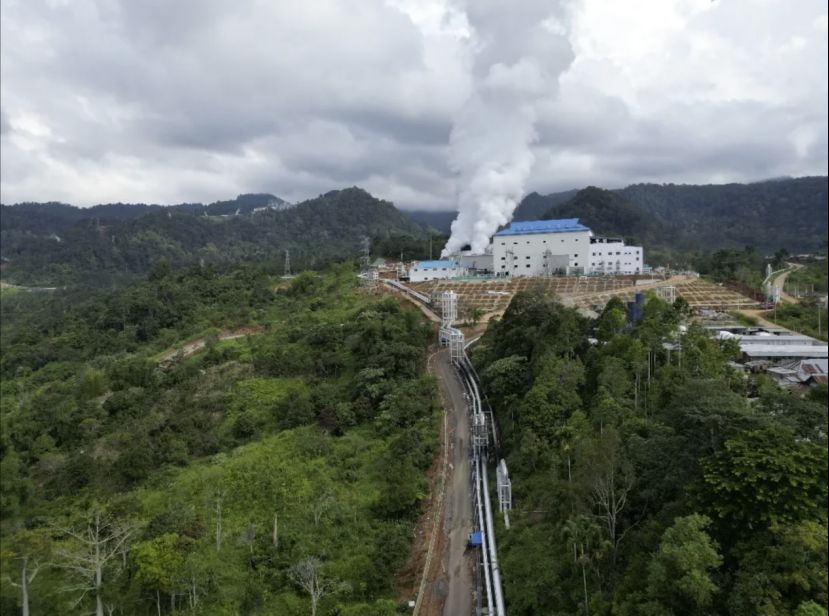
 The Lumut Balai Phase II Geothermal Power Plant Project, after passing a 72-hour continuous reliability operation test, was approved by the Ministry of Energy and Mineral Resources and the State Electricity Company (PLN) and officially commissioned. The project is located in Muara Enim Regency, Palembang City, South Sumatra Province. It involves the construction of a 55 MW (net output) condensing steam turbine generator unit, along with a steam collection system, brine reinjection long-distance pipeline system, transmission lines, and step-up substation facilities. The design was carried out by Southwest China Power Design Institute, a subsidiary of China Energy Engineering Group. This project is a "single-flash" geothermal power plant project fully executed and successfully commissioned by a Chinese company, and it is also the largest single-unit geothermal power generation project designed by a Chinese company in Indonesia, marking a significant breakthrough in the application of Chinese geothermal power technology. As the first overseas geothermal power project of Southwest Institute, it injects strong momentum into China-Indonesia green cooperation and enhances the international influence of Southwest Institute in the field of geothermal power generation. The project successfully achieved the complete engineering application of "single-flash" geothermal power generation technology, providing a model for China's geothermal technology to go global; it optimized the design of long-distance steam collection and transmission systems and brine reinjection systems, maximizing the utilization of medium-temperature geothermal resources, improving power generation efficiency, and maintaining ecological balance; it also optimized the seismic and geological adaptability design of the power plant and pipeline system in response to the volcanic terrain and geological conditions of the project area, ensuring long-term safe and reliable operation. It is also an important project for Indonesia to achieve its target of "adding 5.2 GW of geothermal power generation capacity by 2034, with renewable energy installed capacity accounting for 76% of new power capacity." It can alleviate local power supply constraints and promote regional economic and social development.
Geothermal Power Plant Designed by Chinese Company Officially Commissioned
www.indoent.com
2025-07-05
The Lumut Balai Phase II Geothermal Power Plant Project, after passing a 72-hour continuous reliability operation test, was approved by the Ministry of Energy and Mineral Resources and the State Electricity Company (PLN) and officially commissioned. The project is located in Muara Enim Regency, Palembang City, South Sumatra Province. It involves the construction of a 55 MW (net output) condensing steam turbine generator unit, along with a steam collection system, brine reinjection long-distance pipeline system, transmission lines, and step-up substation facilities. The design was carried out by Southwest China Power Design Institute, a subsidiary of China Energy Engineering Group. This project is a "single-flash" geothermal power plant project fully executed and successfully commissioned by a Chinese company, and it is also the largest single-unit geothermal power generation project designed by a Chinese company in Indonesia.
The Lumut Balai Phase II Geothermal Power Plant Project, after passing a 72-hour continuous reliability operation test, was approved by the Ministry of Energy and Mineral Resources and the State Electricity Company (PLN) and officially commissioned. The project is located in Muara Enim Regency, Palembang City, South Sumatra Province. It involves the construction of a 55 MW (net output) condensing steam turbine generator unit, along with a steam collection system, brine reinjection long-distance pipeline system, transmission lines, and step-up substation facilities. The design was carried out by Southwest China Power Design Institute, a subsidiary of China Energy Engineering Group. This project is a "single-flash" geothermal power plant project fully executed and successfully commissioned by a Chinese company, and it is also the largest single-unit geothermal power generation project designed by a Chinese company in Indonesia, marking a significant breakthrough in the application of Chinese geothermal power technology. As the first overseas geothermal power project of Southwest Institute, it injects strong momentum into China-Indonesia green cooperation and enhances the international influence of Southwest Institute in the field of geothermal power generation. The project successfully achieved the complete engineering application of "single-flash" geothermal power generation technology, providing a model for China's geothermal technology to go global; it optimized the design of long-distance steam collection and transmission systems and brine reinjection systems, maximizing the utilization of medium-temperature geothermal resources, improving power generation efficiency, and maintaining ecological balance; it also optimized the seismic and geological adaptability design of the power plant and pipeline system in response to the volcanic terrain and geological conditions of the project area, ensuring long-term safe and reliable operation. It is also an important project for Indonesia to achieve its target of "adding 5.2 GW of geothermal power generation capacity by 2034, with renewable energy installed capacity accounting for 76% of new power capacity." It can alleviate local power supply constraints and promote regional economic and social development.
Share to
Related Reading
 China Investment News
China's AiMOGA Humanoid Robot Obtains Three International Certifications
2026-09-07 China Investment News
Only Three Chinese Automakers Have Independently Built Factories in Indonesia
2026-09-05 Chinese Investment News