
 The Chairman of the Indonesian Bauxite Mining Association stated that several Chinese companies are entering Indonesia's aluminum industry through Industrial Business Licenses (IUI), representing investments in non-integrated smelters. Investment in independent smelters is relatively easier and simpler than integrated investments starting from upstream mining. Currently, some projects from bauxite refineries to aluminum smelters face financing difficulties, and some investors are adopting a wait-and-see attitude toward investing in the bauxite industry. The Ministry of Energy and Mineral Resources recorded that 10 smelters holding Mining Production Operation Licenses (IUP OP) have not yet completed their projects. This type of license requires integrated investment from upstream mining to refineries and smelters. Currently, only two companies have completed smelter construction: PT Well Harvest Winning Alumina and the Smelter Grade Alumina Refinery (SGAR) in Bengkayang, West Kalimantan Province. The 10 smelters that were fined are negotiating in hopes of building the smelters without penalties. Smelters built under IUI can be completed faster with a shorter process than those under IUP OP. Indonesia currently has 14 integrated mineral smelter projects with a total investment of US$8.69 billion (approximately IDR 144.02 trillion), primarily in the bauxite sector, of which 6 integrated bauxite smelter projects under construction represent an investment of US$2.18 billion. Seven bauxite smelter projects have construction progress below 60%, and the license of PT Kalbar Bumi Perkasa in Sanggau, West Kalimantan Province, has been revoked. Due to domestic production restrictions, Chinese companies such as Tsingshan Holding Group, China Hongqiao Group Limited, and Shandong Nanshan Aluminum have turned their attention to Indonesia, the largest economy in Southeast Asia, investing heavily in building new smelters and refineries. Goldman Sachs Group estimates that Indonesia's aluminum production capacity could increase fivefold by the end of this decade. A consulting firm director believes that Indonesia will become the global center of the aluminum industry within the next five years.
Chinese Companies Aggressively Enter Indonesia's Aluminum Industry
www.indoent.com
2025-07-19
The Chairman of the Indonesian Bauxite Mining Association stated that several Chinese companies are entering Indonesia's aluminum industry through Industrial Business Licenses (IUI), representing investments in non-integrated smelters. Investment in independent smelters is relatively easier and simpler than integrated investments starting from upstream mining. Currently, some projects from bauxite refineries to aluminum smelters face financing difficulties, and some investors are adopting a wait-and-see attitude toward investing in the bauxite industry. The Ministry of Energy and Mineral Resources recorded that 10 smelters holding Mining Production Operation Licenses (IUP OP) have not yet completed their projects. This type of license requires integrated investment from upstream mining to refineries and smelters.
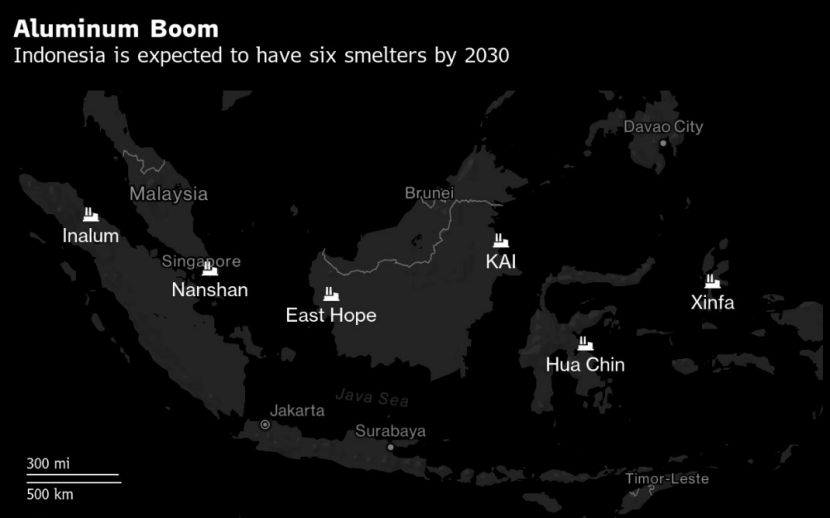
The Chairman of the Indonesian Bauxite Mining Association stated that several Chinese companies are entering Indonesia's aluminum industry through Industrial Business Licenses (IUI), representing investments in non-integrated smelters. Investment in independent smelters is relatively easier and simpler than integrated investments starting from upstream mining. Currently, some projects from bauxite refineries to aluminum smelters face financing difficulties, and some investors are adopting a wait-and-see attitude toward investing in the bauxite industry. The Ministry of Energy and Mineral Resources recorded that 10 smelters holding Mining Production Operation Licenses (IUP OP) have not yet completed their projects. This type of license requires integrated investment from upstream mining to refineries and smelters. Currently, only two companies have completed smelter construction: PT Well Harvest Winning Alumina and the Smelter Grade Alumina Refinery (SGAR) in Bengkayang, West Kalimantan Province. The 10 smelters that were fined are negotiating in hopes of building the smelters without penalties. Smelters built under IUI can be completed faster with a shorter process than those under IUP OP. Indonesia currently has 14 integrated mineral smelter projects with a total investment of US$8.69 billion (approximately IDR 144.02 trillion), primarily in the bauxite sector, of which 6 integrated bauxite smelter projects under construction represent an investment of US$2.18 billion. Seven bauxite smelter projects have construction progress below 60%, and the license of PT Kalbar Bumi Perkasa in Sanggau, West Kalimantan Province, has been revoked. Due to domestic production restrictions, Chinese companies such as Tsingshan Holding Group, China Hongqiao Group Limited, and Shandong Nanshan Aluminum have turned their attention to Indonesia, the largest economy in Southeast Asia, investing heavily in building new smelters and refineries. Goldman Sachs Group estimates that Indonesia's aluminum production capacity could increase fivefold by the end of this decade. A consulting firm director believes that Indonesia will become the global center of the aluminum industry within the next five years.
Share to
Related Reading
 China Investment News
China's AiMOGA Humanoid Robot Obtains Three International Certifications
2026-09-07 China Investment News
Only Three Chinese Automakers Have Independently Built Factories in Indonesia
2026-09-05 Chinese Investment News