
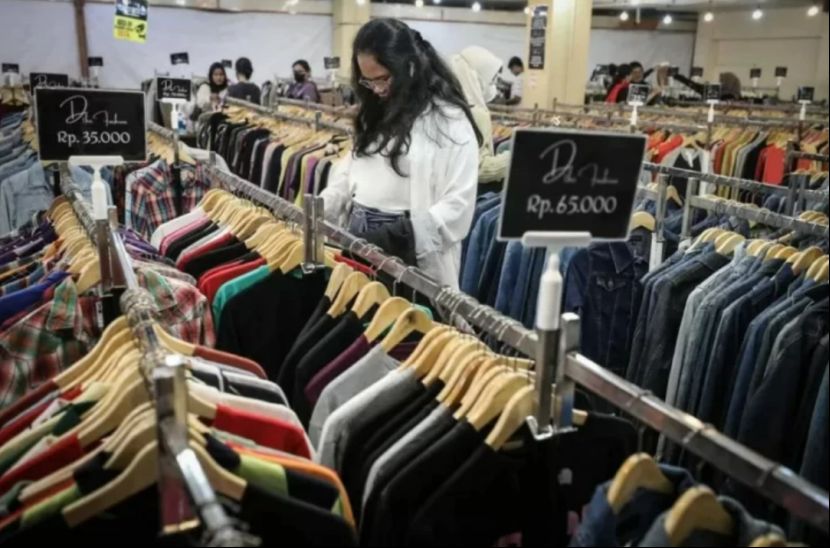
 The Indonesian government stated that its crackdown on imported goods goes beyond combating second-hand clothing trade and will also target new goods flooding the domestic market.
The Minister of SMEs revealed that the government is preparing to restrict untagged Chinese new goods lacking proper supervision from entering Indonesia. He pointed out that the biggest problem faced by MSMEs is not only the proliferation of second-hand imported clothing but also the uncontrolled influx of large quantities of new imported goods via containers.
These goods include clothing, shoes, trousers, watches, and other items, without product identification, standard labels, or quality screening. They are shipped in containers without screening or restrictions, which is what the government intends to address and limit, to make domestic products competitive.
He emphasized that restricting imports is not about closing international trade, but ensuring local products have room to develop. The government only allows imports of goods that cannot be produced domestically, while goods that can be produced locally need to be restricted, giving local products market access and growth opportunities.
Previous efforts to crack down on second-hand imported clothing have shown results, and the focus now shifts to tackling illegal new imported goods to balance the trade ecosystem and prevent domestic industries from being continuously suppressed by unregulated cheap goods and unfair competition.
The Indonesian government stated that its crackdown on imported goods goes beyond combating second-hand clothing trade and will also target new goods flooding the domestic market.
The Minister of SMEs revealed that the government is preparing to restrict untagged Chinese new goods lacking proper supervision from entering Indonesia. He pointed out that the biggest problem faced by MSMEs is not only the proliferation of second-hand imported clothing but also the uncontrolled influx of large quantities of new imported goods via containers.
These goods include clothing, shoes, trousers, watches, and other items, without product identification, standard labels, or quality screening. They are shipped in containers without screening or restrictions, which is what the government intends to address and limit, to make domestic products competitive.
He emphasized that restricting imports is not about closing international trade, but ensuring local products have room to develop. The government only allows imports of goods that cannot be produced domestically, while goods that can be produced locally need to be restricted, giving local products market access and growth opportunities.
Previous efforts to crack down on second-hand imported clothing have shown results, and the focus now shifts to tackling illegal new imported goods to balance the trade ecosystem and prevent domestic industries from being continuously suppressed by unregulated cheap goods and unfair competition.
Indonesia Restricts Import of Untagged Chinese Goods
www.indoent.com
2025-12-09
The Indonesian government stated that its crackdown on imported goods goes beyond combating second-hand clothing trade and will also target new goods flooding the domestic market. The Minister of SMEs revealed that the government is preparing to restrict untagged Chinese new goods lacking proper supervision from entering Indonesia. He pointed out that the biggest problem faced by MSMEs is not only the proliferation of second-hand imported clothing but also the uncontrolled influx of large quantities of new imported goods via containers. These goods include clothing, shoes, trousers, watches, and other items, without product identification, standard labels, or quality screening. They are shipped in containers
The Indonesian government stated that its crackdown on imported goods goes beyond combating second-hand clothing trade and will also target new goods flooding the domestic market.
The Minister of SMEs revealed that the government is preparing to restrict untagged Chinese new goods lacking proper supervision from entering Indonesia. He pointed out that the biggest problem faced by MSMEs is not only the proliferation of second-hand imported clothing but also the uncontrolled influx of large quantities of new imported goods via containers.
These goods include clothing, shoes, trousers, watches, and other items, without product identification, standard labels, or quality screening. They are shipped in containers without screening or restrictions, which is what the government intends to address and limit, to make domestic products competitive.
He emphasized that restricting imports is not about closing international trade, but ensuring local products have room to develop. The government only allows imports of goods that cannot be produced domestically, while goods that can be produced locally need to be restricted, giving local products market access and growth opportunities.
Previous efforts to crack down on second-hand imported clothing have shown results, and the focus now shifts to tackling illegal new imported goods to balance the trade ecosystem and prevent domestic industries from being continuously suppressed by unregulated cheap goods and unfair competition.
Tags
Industry News
Share to
Related Reading
 Industry Flash
Cheap Chinese Plastics Impact Indonesia's Petrochemical Industry, Association Calls for Protection
2026-09-03 Industry News
Investment Heat in Two Key Industrial Parks in Central Java Continues to Rise
2026-08-31 Industry News