
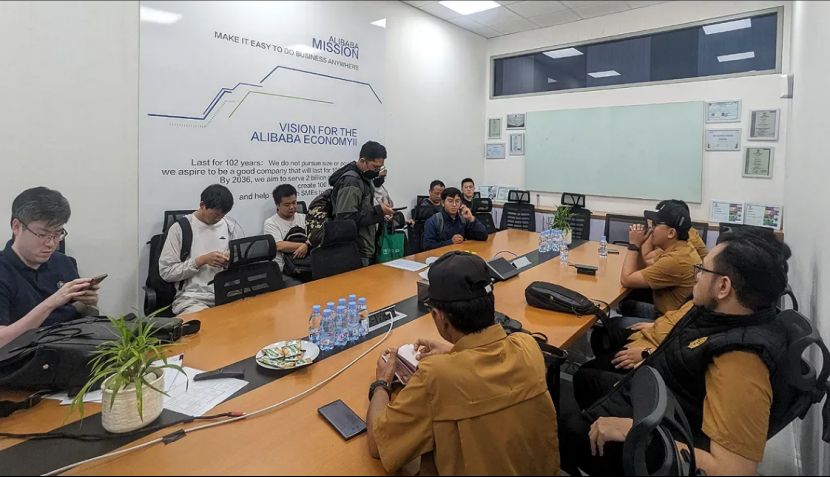
 Based on the directive of the Director General of Immigration, the Bekasi Immigration Office conducted joint inspections on multiple foreign-invested enterprises within its jurisdiction to monitor foreign workers, maintain national security and stability, and enhance public trust in immigration authorities. A local South Korean automotive company employed 52 South Korean employees, all holding valid Limited Stay Permits (ITAS), with no immigration violations found. Another Chinese-invested automotive company employed 19 Chinese employees, 18 of whom held ITAS issued by the local immigration office, and one held ITAS issued by the South Jakarta Immigration Office. However, issues were identified: the registered positions on the employees' ITAS did not match their actual positions—for example, one person registered as a Production Consultant was actually a Manufacturing Integration Manager. Internal company documents showed irregularities, with some foreign employees' work locations inconsistent with the records in the Foreign Worker Utilization Plan (RPTKA). Meanwhile, five Chinese employees working at a local Chinese-invested photovoltaic company were unable to provide their RPTKA and proof of residence, and one claimed to reside in a local apartment. The Immigration Office will conduct an in-depth investigation into these findings. If violations are confirmed, immigration administrative measures will be taken in accordance with regulations, and the deportation of violators is not excluded. This operation is not merely routine administrative work but a crucial step in national law enforcement, maintaining legal certainty, and detecting potential threats from foreign nationals, demonstrating the Immigration Directorate General's commitment to strengthening immigration supervision and upholding territorial legal integrity.
Large Number of Chinese Workers from Chinese Enterprises at Risk of Deportation
www.indoent.com
2025-07-23
Based on the directive of the Director General of Immigration, the Bekasi Immigration Office conducted joint inspections on multiple foreign-invested enterprises within its jurisdiction to monitor foreign workers, maintain national security and stability, and enhance public trust in immigration authorities. A local South Korean automotive company employed 52 South Korean employees, all holding valid Limited Stay Permits (ITAS), with no immigration violations found. Another Chinese-invested automotive company employed 19 Chinese employees, 18 of whom held ITAS issued by the local immigration office, and one held ITAS issued by the South Jakarta Immigration Office. However, issues were identified: the registered positions on the employees' ITAS did not match their actual positions—for example, one person registered as a Production Consultant was actually a Manufacturing Integration Manager. Internal company documents showed irregularities, with some foreign employees' work locations inconsistent with the records in the Foreign Worker Utilization Plan (RPTKA). Meanwhile, five Chinese employees working at a local Chinese-invested photovoltaic company were unable to provide their RPTKA and proof of residence, and one claimed to reside in a local apartment. The Immigration Office will conduct an in-depth investigation into these findings. If violations are confirmed, immigration administrative measures will be taken in accordance with regulations, and the deportation of violators is not excluded. This operation is not merely routine administrative work but a crucial step in national law enforcement, maintaining legal certainty, and detecting potential threats from foreign nationals, demonstrating the Immigration Directorate General's commitment to strengthening immigration supervision and upholding territorial legal integrity.
Based on the directive of the Director General of Immigration, the Bekasi Immigration Office conducted joint inspections on multiple foreign-invested enterprises within its jurisdiction to monitor foreign workers, maintain national security and stability, and enhance public trust in immigration authorities. A local South Korean automotive company employed 52 South Korean employees, all holding valid Limited Stay Permits (ITAS), with no immigration violations found. Another Chinese-invested automotive company employed 19 Chinese employees, 18 of whom held ITAS issued by the local immigration office, and one held ITAS issued by the South Jakarta Immigration Office. However, issues were identified: the registered positions on the employees' ITAS did not match their actual positions—for example, one person registered as a Production Consultant was actually a Manufacturing Integration Manager. Internal company documents showed irregularities, with some foreign employees' work locations inconsistent with the records in the Foreign Worker Utilization Plan (RPTKA). Meanwhile, five Chinese employees working at a local Chinese-invested photovoltaic company were unable to provide their RPTKA and proof of residence, and one claimed to reside in a local apartment. The Immigration Office will conduct an in-depth investigation into these findings. If violations are confirmed, immigration administrative measures will be taken in accordance with regulations, and the deportation of violators is not excluded. This operation is not merely routine administrative work but a crucial step in national law enforcement, maintaining legal certainty, and detecting potential threats from foreign nationals, demonstrating the Immigration Directorate General's commitment to strengthening immigration supervision and upholding territorial legal integrity.
Tags
Social Updates
Share to


