
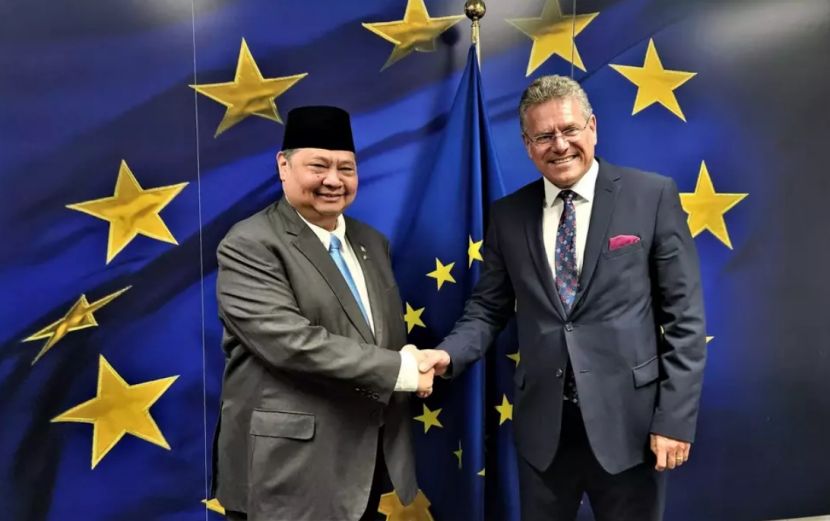
 The Coordinating Minister for Economic Affairs recently announced that Indonesia and the EU have concluded the Comprehensive Economic Partnership Agreement (CEPA) after 9 years and 19 rounds of negotiations. After meeting with the EU Trade and Economic Security Commissioner, he confirmed that all outstanding issues have been resolved and will be reported to the leaders of both countries. The EU is Indonesia's fifth largest trading partner, with bilateral trade reaching USD 30.1 billion in 2024, and Indonesia enjoying a trade surplus of USD 4.5 billion with the EU. Against the backdrop of global economic instability, this agreement is significant for strengthening bilateral cooperation and stabilizing global supply chains. Within 1-2 years of implementation, 80% of Indonesia's exports to the EU will enjoy zero tariffs, benefiting labor-intensive industries as well as palm oil, fisheries, renewable energy, electric vehicles, and other sectors. The EU focused on local content requirements, the automotive industry, access to critical minerals, and foreign investment incentives during negotiations; Indonesia sought fair treatment for its fishery exports, and the EU agreed to provide a level playing field. Additionally, the EU pledged special consideration for Indonesia regarding deforestation policies, which will facilitate Indonesia's exports of forest-related products. CEPA is expected to enhance Indonesia's global competitiveness, with exports to the EU projected to grow by over 50% in the next 3-4 years, attract strategic European investment, and boost international confidence in Indonesia's legal and business environment.
Indonesia and EU Conclude Economic Partnership Agreement Negotiations
www.indoent.com
2025-06-09
The Coordinating Minister for Economic Affairs recently announced that Indonesia and the EU have concluded the Comprehensive Economic Partnership Agreement (CEPA) after 9 years and 19 rounds of negotiations. After meeting with the EU Trade and Economic Security Commissioner, he confirmed that all outstanding issues have been resolved and will be reported to the leaders of both countries. The EU is Indonesia's fifth largest trading partner, with bilateral trade reaching USD 30.1 billion in 2024, and Indonesia enjoying a trade surplus of USD 4.5 billion with the EU. Against the backdrop of global economic instability, this agreement is significant for strengthening bilateral cooperation and stabilizing global supply chains. Within 1-2 years of implementation, 80% of Indonesia's exports to the EU will enjoy zero tariffs.
The Coordinating Minister for Economic Affairs recently announced that Indonesia and the EU have concluded the Comprehensive Economic Partnership Agreement (CEPA) after 9 years and 19 rounds of negotiations. After meeting with the EU Trade and Economic Security Commissioner, he confirmed that all outstanding issues have been resolved and will be reported to the leaders of both countries. The EU is Indonesia's fifth largest trading partner, with bilateral trade reaching USD 30.1 billion in 2024, and Indonesia enjoying a trade surplus of USD 4.5 billion with the EU. Against the backdrop of global economic instability, this agreement is significant for strengthening bilateral cooperation and stabilizing global supply chains. Within 1-2 years of implementation, 80% of Indonesia's exports to the EU will enjoy zero tariffs, benefiting labor-intensive industries as well as palm oil, fisheries, renewable energy, electric vehicles, and other sectors. The EU focused on local content requirements, the automotive industry, access to critical minerals, and foreign investment incentives during negotiations; Indonesia sought fair treatment for its fishery exports, and the EU agreed to provide a level playing field. Additionally, the EU pledged special consideration for Indonesia regarding deforestation policies, which will facilitate Indonesia's exports of forest-related products. CEPA is expected to enhance Indonesia's global competitiveness, with exports to the EU projected to grow by over 50% in the next 3-4 years, attract strategic European investment, and boost international confidence in Indonesia's legal and business environment.
Tags
Social Updates
Share to


